Introduction
On first thought, the materiality of water and the technology of virtual reality (VR) make a jarring match. Yet at Venice Immersive, a subsection of the Venice Film Festival dedicated specifically to showcasing the latest immersive arts and media made for the emergent ludo-cinematic medium, the two meet yearly. Water threatens the machine, and indeed, on the isle of Lazzaretto Vecchio where the festival takes place, pools of water lap directly into the building not far from the computers, routers, and wires beeping nearby. During my visit, each morning begins with a boat ride to the isle, the image of the glistening water remaining on my mind and its movement in my body. Then, when I put on my headset and immerse, I see that image again, and again, and again. By the end of the week, I have counted over twenty VR pieces that feature submergence into virtual waters. So, it seems that water and immersion, that which VR technology promises to afford, are surprisingly right together.
In this review of Venice Immersive 2025, I will analyze how water functions as the festival’s core topos, how water plays a central role in the lineup, what narrative and material relationships water and VR technology maintain with one another, and how the festival’s locale itself becomes a liminal spatiality where spatiotemporal boundaries liquefy.
Immersion on the Isle of the Virtual
Lazzaretto Vecchio is less an island than a floating structure suspended in water. The oldest version dates back to the 1400s, when it functioned as a plague isle—there are still mass burial sites in the sedentary bedrock underneath the building today (Valsecchi 2007). Like much of Venice itself, entering Lazzaretto Vecchio feels like stepping back in time. Yet, as I step from dock into doorway, I am also propelled into futurity as corridors stretch out housing numerous booths stocked with cutting-edge immersive technologies—Apple Vision Pros, Quest 3s, unreleased Samsung Moohan prototypes. As I glance into one of the booths, someone in a swivel chair turns my way. Against the background of the medieval building, as they stare at me with a strange three-eyed headset covering their face, I feel a sudden sense of total temporal incongruity. Unaware of me, the person swivels away again, fully immersed somewhere else.
Immersion refers to a condition of being plunged into a fluid or transferred into an environment.[1] Immersion may shift the spatiotemporal relationship between a body and the enveloping substance, as Plato demonstrates in Phaedo through pointing a straight stick in water. Showing how it appears bent, Plato relays how water and immersion trouble and dissolve stable referentiality, liquefying edges, making it hard to distinguish reality from the distorted images of the unreal (Plato 1993, quoted in D’Aloia 2012).[2]
While the user is immersed in VR, the headset’s screen tends to recede from the user’s perception, not unlike McLuhan’s deep-sea fish, who, he argued, can neither perceive nor understand water because they are too immersed within it (McLuhan and Fiore 2001). This is perhaps a clue as to why so many VR artists seem instinctively drawn to the watery: Water is both distinctly material and immaterial, vexed between mediated and unmediated (Peters 2015). In seemingly removing the frame, VR too is a medium, “meant to liquify itself as representation” (Andrejevic and Volcic 2019), working to become indistinguishable from experience itself. As such, VR is also associated with the grammars of the assumedly direct, affective, and emotional, imagined to enable its users to gain deeper empathetic understanding of another’s truth (Nakamura 2020).[3]
Yet, unlike McLuhan’s unknowing fish, we might probe the watery immersions of VR and question what their narrative metaphors bring to shore. Below, I will discuss the four functions of submergence that I identified within the Venice Immersive 2025 lineup: submergence as encroaching death; as entry portal to another world; as a state of being within the psyche; and as the moment of psychological transformation. Moreover, as Rogers points out, “screens continue to contribute materially to the experience of immersion, even (indeed, especially) when they recede from the user’s consciousness” (2019, 136). As such, I will also consider how the materiality of the VR headset contributes to immersion, and when it vexes the machine’s desire to plunge into unmediated (un)reality.
The Narratives and Materialities of Watery VR
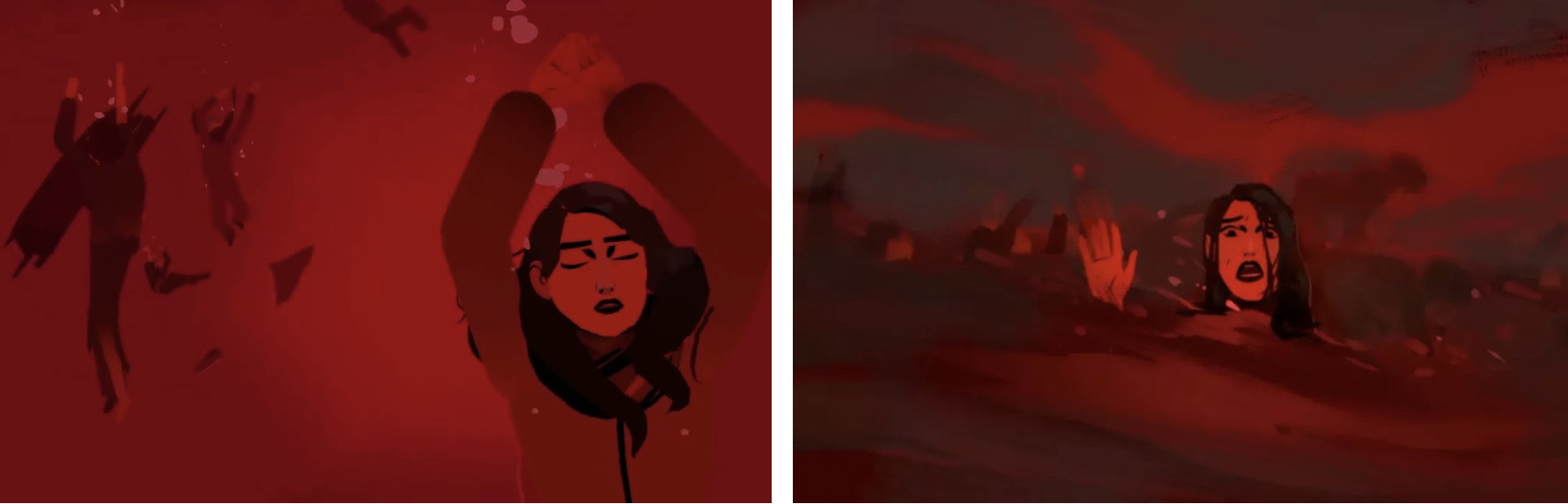
Within the lineup, various titles revolve around adventurous submergence. Adventure: Ice Dive (Mikkelborg and Geffen 2024) and Submerged (Berger 2024) depict people braving underwater worlds, my body hovering next to theirs. As the protagonists (and me, with them) eventually emerge victorious over and out of the water, the narrative catharsis maps my own body to an embodied sense of triumph—and thereby onto long genealogies of capitalist-colonial ventures to “tame,” “transcend,” and “civilize” the ocean (Stifjell 2024).[4] Two other titles explore water’s danger without pleasurable victory: Out of Nowhere (Hofmann and Wuthe 2025), created as part of an Austrian climate-change awareness campaign, embodies me in the memory of a long, anxious drowning scene of the narrator’s home, while I imagine how I might react in such a situation. Drowning is also threefold explored in Less than 5 Gr of Saffron (Motevalymeidanshah 2025) (figure 1), which depicts traumatic memories resurfacing within a refugee girl. In the opening scene, I am slammed into her body, a plunging sound suggesting I have entered her unconscious. Looking down, I find two animated hands where mine should be as I prepare a dish, its smell triggering memories as the kitchen fills up with blood. Immersed in its red haze, I see her journey across the ocean, her mother’s arm wrapped around my body. Finally, I sink into the water with her family as the boat sinks. These three submersions correspond to the functions of water as portal, as memory, and as death. Each affects me greatly, and I sob into my headset. It sits so snugly against my face that the liquid becomes trapped, creating a strange form of submergence within my own liquidity. Ironically, while the work appeals to my emotions, my tears break the unmediation, and momentarily I cease to be McLuhan’s fish as I readjust the sweaty headset to sit less uncomfortably on my face.
.png)
.png)
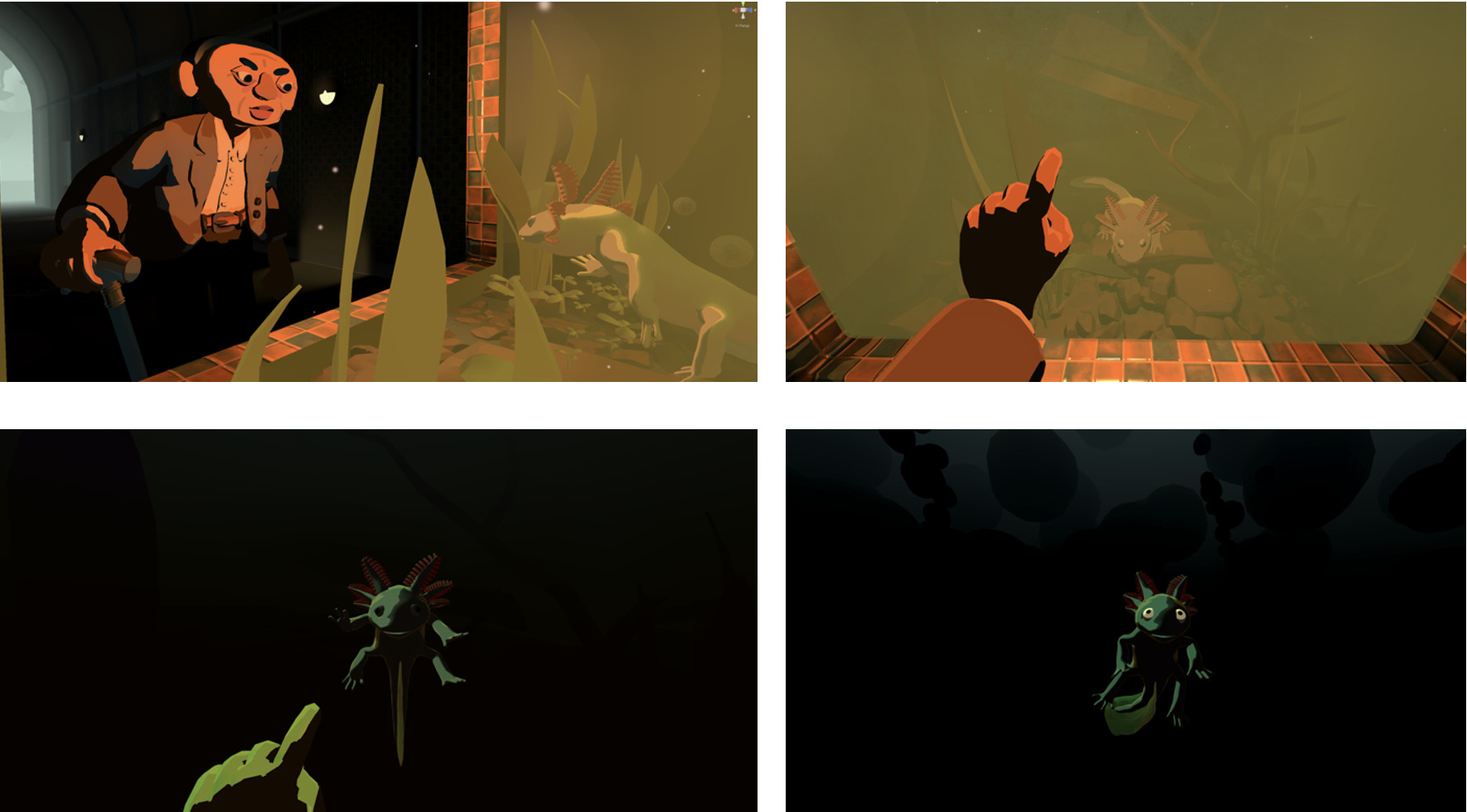
Many of the VRs submerge me into the unconscious of another. This occurs through two distinct modes: water as a portal into the unconscious, and wateriness as the state of being suspended within it. In the opening scene of Face Jumping (Gorman and Cannizzaro 2025), I am an old man looking at an aquarium. The axolotl hovering there pulls me into the water, setting me off on a strange journey of seeing the world through the eyes of all sorts of entities (figure 2).[5] Sense of Nowhere (Yeh 2025) differentiates between the two states via different liquidities. In the opening scene, my invisible body hovers in rainy darkness while footsteps pass me by. When I swing my hands upward, the rain envelops me and I plunge into the interiority of the passerby. Her unconscious is made of that which occupies her mind: the vegetable soup for dinner that night. For the remainder of the story, I hover in orange liquid among giant broccoli as childhood memories unfold around me.
Various works explore water as psychological transformation. In Dark Rooms (Damsbo, Flensted Jensen, and Steen Sverdrup 2025), I stand in a metro station beginning to flood. As I plunge downward into the narrator’s world, they recall how getting off at this particular Berlin station long ago meant liberation from their homophobic past. In La Magie Opera (Astruc 2025), a weary singer leads me down a waterscape to the memory of when she fell in love with opera. We listen to Dvořák’s Rusalka while I play with the bubbles to the rhythm of the song.[6] For others, water signifies (ego) death. In La fille qui explose VR (Poggi and Vinel 2025), the female protagonist is swallowed by a watery vortex filled with objects of the capitalist hellscape that has caused her to start exploding on the daily; in L’ombre (Li and Canat De Chizy 2025), an adaptation of the Hans Christian Andersen story about a composer whose shadow kills him, we go underwater the moment the shadow subsumes him.
For the protagonist in the live mixed-reality Blur (Quintero and Greenberg 2025), water constitutes both a portal to the underworld and the fluids of the body that may help her find a way out, if she succeeds in cloning her deceased child. I trail behind her as we submerge down watery paths into a dark science facility. In the final scene, a live actor invites me to physically pour some water into a petri dish, after which she reveals that I myself was also a subject of cloning: Suddenly, a digitally rendered version of myself stares back at me, almost as if I am seeing my blurry reflection in Plato’s waters, as stupidly unaware of how the technological environment was surveilling and liquefying me as McLuhan’s fish.
.png)
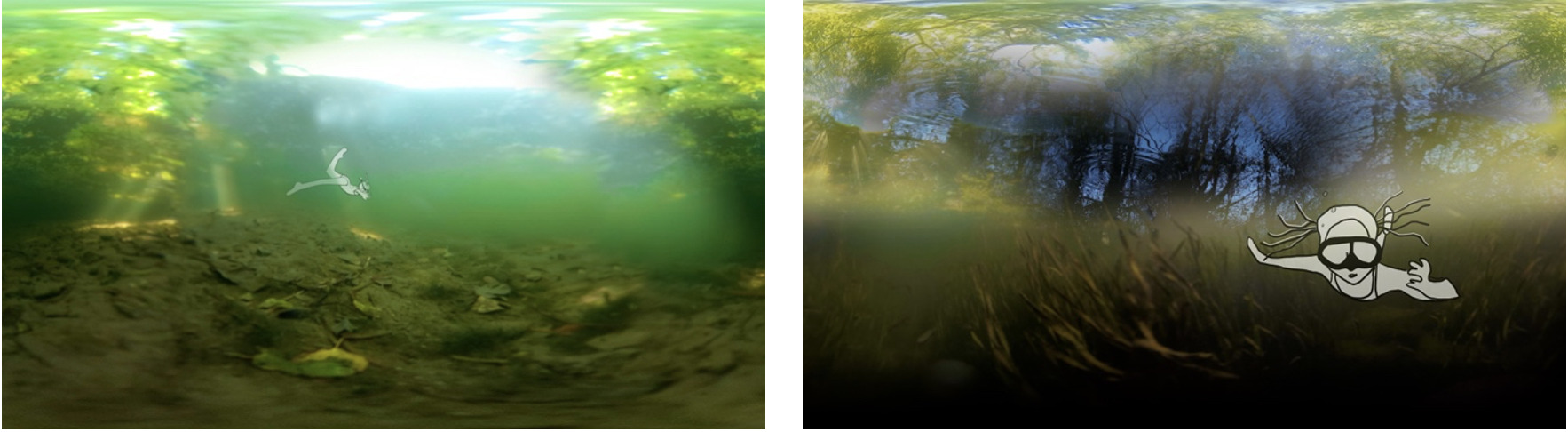
Finally, The Time Before (Metcalf 2025) tells an autobiographical story through animation rendered over underwater film footage that depicts animator Leo Metcalf swimming back in time to memories of an abusive childhood (figure 3). The works combines all four functions of virtual water—as entry portal into and state of transference within the child-Leo’s mind, as impending death drowning under the father’s cruelty, and as psychological transformation when the adult-Leo finally cries about what happened to him. At one point, narrator-Leo breaks the fourth wall by addressing me directly, demanding I empathetically hold my breath with him as we sink down. The strange dialectic at once immerses me deeper and pulls me out, as I suddenly feel the materiality of the headset sitting on my nose while I take a sharp inhale. The headset feels heavy, my bodily awareness heightened as eventually I quietly let oxygen flow back through.
The Experience of Liquidity at Venice Immersive 2025
The topos of the watery plays a core role at Venice Immersive 2025 as a conduit to blur the boundaries between reality, imagination, and memory. VR artists explore watery imagery to intensify the mechanism of ontological blur by emplacing me not only within these characters’ bodies but also into their minds, rendered as waterscapes. I relive their memories virtually yet embodied and mediated by swimming and drowning alongside them. Like Plato’s stick, the wateriness mediates my porous understanding of their stories, suspending not only the spatiotemporal but also the (meta)physical boundaries of where I end and they begin.
Furthermore, the materiality of the headset both troubles and intensifies my liquid experiences—they come to feel almost like diver’s goggles, taking them off a jarring experience as my body tries to readjust to the glaring lights of Lazzaretto Vecchio. The material constraints ironically become the most obvious when I respond to the emotional appeal within the immersivity by either crying or holding my breath. This process vexes VR’s desire to turn me into McLuhan’s fish, undoing some of the smoothness between the supposed dematerialization of the virtual and its claims to the unmediated and the authentic. No matter how watery the environment aims to be, over the week I find that the materiality of VR does not enable users to escape their bodies, but rather more actively anchors them within their own waters as the locus of their experience.
Finally, the festival’s locale too is materially and dialectically made and unmade by its wateriness. Water defines the isle, and Venice more generally, yet the rising sea levels also threaten its existence. Water holds the structure’s memories, keeping its graves intact within its submerged sediment. Water determines the journey toward the festival, the vague seasickness from the morning waves an inherent aspect of the experience of the VR. Like VR, entering the island is a form of immersion into spatiotemporal incongruity, stuck between something long gone and something only just beginning. And so, each time I re-emerge back to Lazzaretto Vecchio from my headset, each lunch break when I sit at the waterfront, each evening on the boat back to my hotel, I take the experience of the water. Venice Immersive presents a particularly wet liminal place. Not a great thing for such a high-tech affair, but upon some reflection, in fact rather fitting.
Acknowledgement
This research was supported by the Dutch Council for Scientific Research (NWO) through the ‘Open Competition SSH’ project Virtual Reality as Empathy Machine: Media, Migration and the Humanitarian Predicament (406.21.CTW.015).
Mediography
Blanca Li, Edith Canat De Chizy, dir. 2025. L’ombre (The Shadow). Film Addict, France Television, Flash Forward Enterntainment, Ircam Centre Pompidou. Mixed Reality.
Caroline Poggi, Jonathan Vinel, dir. 2025. La fille qui explose VR (The exploding girl VR). Atlas V, Byrd. Virtual Reality.
Charlotte Mikkelborg, Anthony Geffen, dir. 2024. Adventure: Ice Dive. Apple Immersive, Atlantic Studios. Virtual Reality.
Craig Quintero, Phoebe Greenberg, dir. 2025. Blur. PHI Studio, Riverbed Theatre, Onassis Culture. Mixed Reality.
Edward Berger, dir. 2024. Submerged. Apple Immersive, TBWAArts Lab, The Sweetshop Films. Virtual Reality.
Hsin-Hsuan Yeh, dir. 2025. Sense of Nowhere. RE:ANIMA Joint Master Consortium. Virtual Reality.
Jonathan Astruc, dir. 2025. La Magie Opera. BackLight, Opéra National de Paris, Vive Arts. Mixed Reality.
Kris Hofmann, Andreas Wuthe, dir. 2025. Out of Nowhere. Hofmann Studio, spec.Studio, Animate Projects. Virtual Reality.
Leo Metcalf, dir. 2024. The Time Before. Virtual Reality.
Mads Damsbo, Laurits Flensted Jensen, Anne Sofie Steen Sverdrup, dir. 2025. Dark Rooms. Morph Film, NowHere Media, NAXS Studio, Makropol, Bedside Productions. Mixed Reality.
Négar Motevalymeidanshah, dir. 2025. Less than 5 Gr of Saffron. Ten2Ten. Virtual Reality.
Samantha Gorman, Danny Cannizzaro, dir. 2025. Facejumping. Tender Claws. Virtual Reality.
Oxford English Dictionary Online, “immersion.” accessed December 18, 2025, http://www.oed.com.
Connery (1996) observes the inherent dialectic of the ocean as suspended between material and immaterial, noting that “liquid is always the problem element—shapeless but not abstract; temporal; changeable” (290). Similarly, Zygmunt Bauman notes in Liquid Modernity (2000): “Fluids […] neither fix space nor bind time. While solids have clear spatial dimensions but neutralise the impact of time (effectively resisting its flow), fluids do not keep to any shape for long and are constantly ready (and prone) to change it; and so for them it is the flow of time that counts, more than the space they happen to occupy. In a sense, solids cancel time; for liquids, on the contrary, it is mostly time that matters” (10).
Böhme (2010) points to the expression of the psychic through water metaphors like “stream of consciousness,” “floating anger,” and “waves of emotions.” In the context of this essay, I might also point to “memories resurfacing” and “drowning in thoughts” as linguistic equivalents of what these VR pieces explore.
Paul Gilroy’s The Black Atlantic (1993) catalyzed a rich field of scholarly inquiry into the ocean and its histories of slavery and colonialism. Additionally, blue humanities scholars like Melody Jue and Astrida Neimanis as well as Black feminist authors like Omise’eke Natasha Tinsley have pointed out how the ocean is also a very real archive of the dead, a graveyard where immigrants still die daily and whose waters maintain the long memories of the drowned and disremembered histories of slavery and colonial violence.
Interestingly, this is precisely the immersive marketing ploy that VR launched its hype cycle with a decade ago (think “the Ultimate Empathy Machine”), but Face Jumping subverts its expectation of interior knowledge by never actually letting me see inside the unconscious at all.
Dvořák’s Rusalka tells the story of a water nymph who falls in love with a human prince swimming in her lake.