On March 22, 2024, Capcom released Dragon’s Dogma 2 for the PlayStation 5, Xbox Series X/S, and PC. The launch was a relative success, and the game sold 2.5 million copies by April 2, eleven days after release (Tsujimoto 2024). Another place the game became popular during the days after its launch was on Twitch.tv, a website dedicated to the livestreaming of video games. On Twitch, anyone can stream any game they want out into the world. In the first nine days after Dragon’s Dogma 2 was released, 20,216 people chose to stream the game for a cumulative 232,892 stream-hours, and those streams were viewed for a commensurate 14,591,329 watch-hours.[1] Dragon’s Dogma 2 opens with a long cutscene and an extended opening tutorial, which is not unusual for a AAA action-adventure title. However, this means that anyone streaming the game from the beginning has to go through that same cutscene and tutorial. For these streamers, especially in the first nine days postrelease, this means they are duplicating the exact same footage as 20,215 other streamers, possibly even at the exact same moment. This duplication phenomenon is the subject of this article and will be approached by answering two questions. First, what is the character of this phenomenon: What are the factors that push so many people to stream the same thing at the same time? Second, what is the price of this phenomenon: What is the ecological toll that all of this duplicated streaming causes, and is it justified?
To answer these questions, we first need to understand the culture of streaming as it impacts streamers who might intentionally or unintentionally end up replicating the same sections of games over and over. To make this phenomenon grounded and material, I have created a video art piece that visualizes and analyzes a specific case duplication. This video piece, alongside other data, will be used to produce an emissions impact analysis of the energy consumption used by streamers, especially streamers completing the same sections of video games. This article will conclude with some thoughts toward the future of streaming production with regard to energy consumption.
Why Streaming?
Video game streaming has been a growing area of academic scholarship over the past ten years. Identified as an important site of modern cultural industry (Johnson and Woodcock 2019; Partin 2023; Taylor 2018), streaming has grown to become an inseparable part of the way video games are understood and appreciated. The characteristic liveness and immediacy of streaming have often caused it to be related to television. In her 2018 book Watch Me Play: Twitch and the Rise of Game Live Streaming, T. L. Taylor relates the phenomenon of streaming to “networked broadcasting.” She sees Twitch and other forms of game streaming as a natural evolution from “. . . television’s classic ‘network era’ in which we all gathered around a box in the living room to watch shows on fixed schedules via a limited selection of channels” (Taylor 2018, 25). In this new era of “networked broadcasting,” the selection of channels has ballooned; at the time of writing, there were 2.3 million channels active on Twitch.tv in the last seven days.[2] While Twitch’s “Just Chatting” category remains its most popular,[3] the majority of these 2.3 million streams do focus on playing games. Through streaming, games are transformed, remediated, and turned into content grist for an endless mill of viewers to consume.
The liveness and immediacy associated with streaming generate an implicit expectation: that what you are seeing is happening right now and is up-to-date. In fact, streaming is current in some respects, just like watching the news is current or watching a football game is current.
The fundamental irony of liveness as it is mediated through television is that once you decide to watch a live football game or the news, more football games are occurring and more news is happening. The same is true of games media: As soon as you start investing time in playing a game, more games are being released. It would be ridiculous to say that streams run “24/7”: Individual streamers must sleep and rest even as they run 6- or 12-hour streams. As Jonathan Crary writes, “24/7” is an “impossible temporality” (Crary 2014, 29). Yet in modern, Westernized societies, Crary writes, “Of course, no individual can ever be shopping, gaming, working, blogging, downloading, or texting 24/7. However, since no moment, place, or situation now exists in which one cannot shop, consume, or exploit networked resources, there is a relentless incursion of the non-time of 24/7 into every aspect of social or personal life” (Crary 2014, 30). This temporality extends into streaming, as well. The games industry runs 24/7, and games are released every day. There are always thousands of people streaming games at any one moment. If you’re not one of them, well, you’d better get online.
The sheer volume of streamers and the understanding of streaming as 24/7 content production have resulted in streaming professionally being extremely precarious labor. Professional streamers often work long hours, stretching into as much of 24/7 as they can reach (Johnson and Woodcock 2019, 14). Some Twitch streamers now run 24/7 channels, always on and streaming.[4] The labor of streaming includes time on the stream itself, with additional administrative work that can take up much more time (Johnson and Woodcock 2019, 16). Streamers often have specific metric-based goals they aim to reach, such as subscriber or viewer count, which Johnson and Woodcock describe as " . . . an internalisation of the metricisation of success according to the ‘popularity principle’, a feature of online platforms of this sort whose algorithmic structures emphasise hierarchy and competition, with those at the top attaining a disproportionately high volume of attention and interest compared to those at the bottom" (Johnson and Woodcock 2019, 16). These metrics and milestones become a gamified process through Twitch’s platform and infrastructure, where precariously employed streamers are encouraged to “compete” for audience share (Panneton 2023). Streamers are thus incentivized to pursue whatever strategy will bring them success on Twitch’s platform. Some streamers play only the same game, while some streamers play games with certain challenges. By far, though, the most common strategy for gaming these metrics and finding success on a 24/7 content platform is playing what is new.
When a new video game is released, it is new to all streamers at the same time, meaning there’s a large convergence of streamers on that game. For instance, consider the spike in streams for Baldur’s Gate 3 in its launch month of August 2023.[5] It was released at a daily peak of 5,192 channels streaming the game in early August and then fell to 2,581 in September and then down to 1,102 in October. This kind of spike and subsequent falloff can be seen in most games that have been released during the existence of video game streaming. What this spike means, though, is that when a new game is released, there is a larger than normal number of streamers who are all streaming the exact same content at the exact same times, even if their commentary and communities may differ from one another. Again, they do this because the goal is often to capture as much audience as possible and to keep their attention as new games are released. Nick Dyer-Witheford and Greig de Peuter discuss Deleuze and Guattari’s “machinic surplus value” (time and attention spent even when not working) in relation to game consoles, which seek to do the same thing (Dyer-Witheford and de Peuter 2009, 77–78). They both want to keep audiences locked into and subjugated by their specific console, game environment, or platform (in this case Twitch) and extract surplus engagement, time, and money. On Twitch, for streamers who aspire to success under capitalism, the consumption of the time and attention of audiences is paramount because Twitch provides for its transformation into traditional surplus value through ads, donations, and subscriptions.
For those streamers, the competition for views is fierce. In all of August 2023, Baldur’s Gate 3 English-language streams were viewed by 836,450 average viewers across 39,740 channels.[6] Overall, 339,683 average viewers, or 40.6 percent of the total viewership, came from 100 channels, or 0.25 percent of the total streamers who streamed the game during that time; 33,340 channels, or 83.9 percent of the total streamers, had 10 or fewer average viewers. Because all of these streams occurred during the release month, they all had to cover the same opening material of the game. Thus, huge numbers of streamers were streaming the same sections of Baldur’s Gate 3 to an extremely small number of people, duplicating opening cutscenes and tutorials ad nauseam to that extremely small audience while popularity-driven relevancy algorithms ensured that the most watched streamers stayed the most popular.
The small viewership streamers, or microstreamers, are a newly studied phenomenon. Mia Consalvo, Marc Lajeunesse, and Andrei Zanescu discuss microstreamers in great detail in their recent book, Streaming by the Rest of Us. As opposed to a frame of streaming as labor, they see it as a leisure activity, albeit one that can have casual and serious participants. This positions microstreaming in a nuanced way; certainly some of these streamers are hoping to “make it big,” but many of them, according to Consalvo et al., are streaming as “one interest among many in their lives, one that may even be abandoned as their interests and available time wane” (Consalvo et al. 2025, 26). While these streamers may not be streaming to attempt to garner attention and build their channel, they are likely still influenced by the games industry hype-and-release cycle that also motivates the popular and highly viewed streamers. At the end of the day, these casual microstreamers are still streaming the same recently released game footage over and over for the same reason the big Twitch streamers are: The games are new.
Dragon’s Dogma 144
The sheer magnitude of this duplication is a nearly impossible thing to imagine. Hundreds of hours of extremely similar video are uniquely created across thousands of individual creators. The democratization of media production (in this case) has given the world the freedom to decide to produce the same thing over and over again.
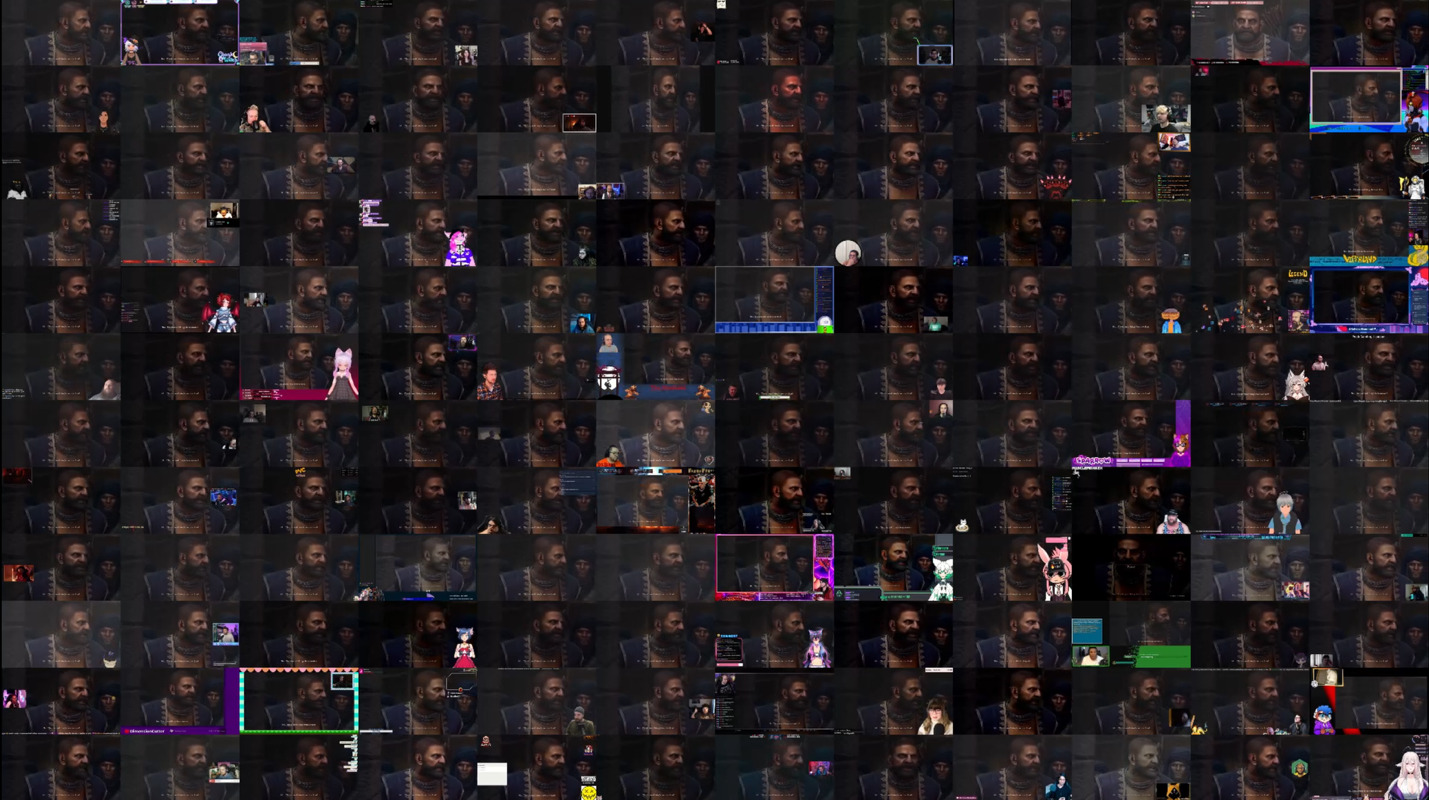
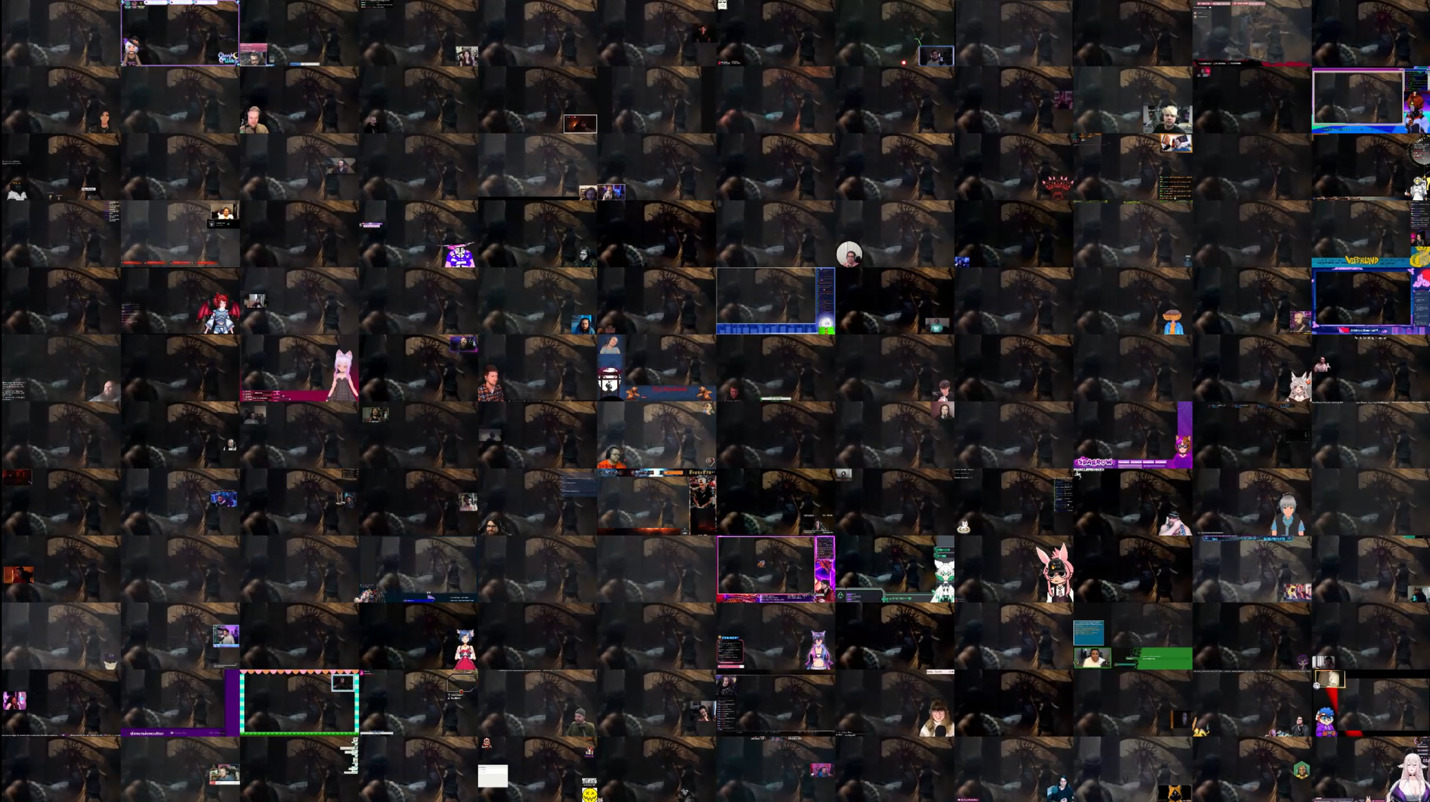
To visualize a small section of this, I created a multichannel video piece titled Dragon’s Dogma 144,[7] which consists of 144 different Twitch streams of the video game Dragon’s Dogma 2 (Capcom, 2024) synchronized across four different key points early in the game: the opening cutscene, the Medusa fight at the end of the tutorial section, the arrival at the first town and the creation of the main pawn (the player’s companion for the rest of the game), and the flashback sequence in the city of Melve. Each segment is ten minutes long, synchronized in such a way that all 144 streams synchronize at the five-minute mark in each segment. The streams included in the project are sourced only from the first nine days of the game’s release, meaning it reflects somewhat the landscape of streams from the first spike after Dragon’s Dogma 2’s release (4,259 peak channels on March 22, 2024).[8] One month later, on April 22, the peak channels that Dragon’s Dogma 2 would hit would be a mere 256, a massive drop and another example of the intense and fleeting attention provided by the Twitch streaming ecosystem.
.png)
The choice to focus on Dragon’s Dogma 2 in this project was a pragmatic one more than anything else. Twitch only saves VODs, or videos on demand, for a certain amount of time after streams have concluded.[9] This means to build any kind of video project of this type, one must scrape the stream videos from Twitch quickly after a game’s release, ideally within seven days (the minimum storage time for past broadcasts), but necessarily within sixty days (the maximum storage time). By the time this paper is published, it will not be possible to create a compilation of these early streams of Dragon’s Dogma 2—at least, not from Twitch’s records. This inherent erasure of stream histories on the platform obfuscates just how much duplication and similarity these streams possess.
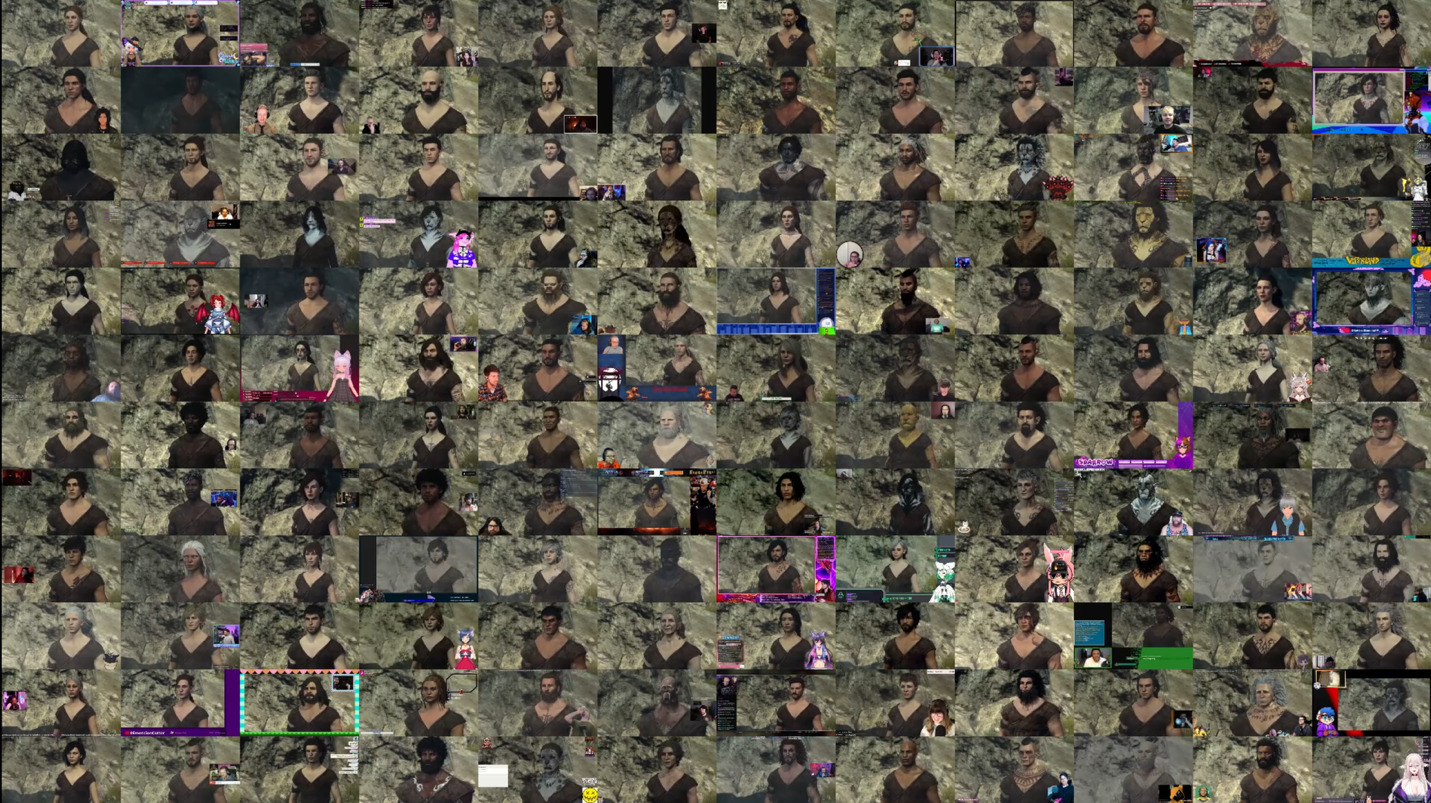
It might at first seem strange to be talking about things like “similarity” and “duplication” when discussing streams of games like Baldur’s Gate 3 or Dragon’s Dogma 2, both of which are open world RPGs where the character’s appearance and abilities are chosen by the player. This is especially true of Dragon’s Dogma 2, which puts a large emphasis on world exploration. I would never assert that streams are exactly the same with no unique footage belonging to them. In fact, that’s a key part of games that differentiates them from other media, the small nuances of interactivity that differentiate game experiences even in more linear game formats. Still, games, like all other media, are finite and cannot contain infinite possibilities. In fact, a game with infinite possibilities would be quite difficult to market and sell as it would have no common qualities or features to advertise. Even in games with many branching paths and detailed customization, there are still often major “bottlenecks” of play that bring all players into relative parity with each other. This is specifically the type of footage that I argue is being heavily duplicated across game streaming, and this is certainly true in Dragon’s Dogma 2. Consider the following moment of the project:
.png)
This moment occurs twenty-five minutes into Dragon’s Dogma 144, in the third synchronized segment, and fairly early into the game Dragon’s Dogma 2. The player character is approaching a village for the first time, and this is a close-up of their face in a cutscene as they do so. There are obvious variances between the streams here both in stream overlay and in game content: Some streamers have many banners and onscreen information, while others have much less or none at all. Some streamers use a real-life camera feed onscreen, while others use digital avatars to represent themselves. Some player characters are men, some are women, some are cat people (called “beastren”), and most are humans. Their skin (or fur) can be a variety of different colors, and their facial structure can vary greatly. That being said, it’s immediately clear that this is the exact same moment in every streamer’s play experience. Their characters are in the exact same position, the camera angle is the exact same, the lighting is (mostly) the same, and what follows is an identical cutscene for each of these 144 streamers.
Of course, different streamers have different personalities and styles of commentary and cultivate different kinds of communities around their streams. This project doesn’t give insight into those communities; it only provides video. Any other stream-external resources such as the chat or Discord-hosted stream communities are not represented. However, streamer personalities can be at least partially observed in Dragon’s Dogma 144: No two streamers say the exact same things, of course (though some common jokes or observations on certain parts of the game do repeat across streams), but they do still all follow the same game flow. While various streamers might reach certain areas depicted in Dragon’s Dogma 144 at different times in their various streams, they do eventually and necessarily reach those points.
Dragon’s Dogma 144 therefore highlights the tension between games as playable objects and games as spectated objects. Having regulated and consistent player experience for games as an individually and privately played medium makes logical sense from an audience consumption and reception perspective: You want to ensure that people who engage with your game have some kind of baseline experience. This is helpful for testing, and this is helpful for marketing. Even games with more procedural and emergent systems (No Man’s Sky, Dwarf Fortress, etc.) still have very intentional limits on what those systems can do.
T. L. Taylor and others have argued rightly that spectatorship has always been a part of games culture (Taylor 2018, 22). However, the nature of spectatorship has changed dramatically with the rise of streaming culture: Local spectatorship (in arcades, in the home, etc.) has evolved to global spectatorship and placed streamers in direct relationship to other streamers in a way that playing games for others to watch has rarely been positioned before, especially in the world of noncompetitive single-player games. However, when you view a stream on Twitch.tv, the existence of the hundreds or thousands of other streams of the same game is pushed to the background and hidden from the viewer—usually, you just watch one stream at a time. Dragon’s Dogma 144 is one way of making what is often an unnoticed aspect of streaming culture instead explicit and visible. What becomes apparent when one makes these comparisons is the fundamental repetition of game footage and scenarios across hundreds and hundreds of streams.
This is not the first project to approach replication in internet-based video. Dragon’s Dogma 144 has obvious resonances with Natalie Bookchin’s multichannel video works, such as Mass Ornament (Bookchin 2009b), which collects multiple synchronized YouTube dance videos, or projects like Laid Off (Bookchin 2009a) or My Meds (Bookchin 2009c), which collect multiple vlogs synchronized around certain topics, such as being fired or being prescribed medication. Wendy Chun has written about the ways these projects highlight both the cynical and the hopeful, where “. . . Bookchin’s rows of Youtube.com videos reveal private actions as forms of repetition” (Chun 2017, 173) and at the same time are “. . . a hopeful revelation of an unconscious community or what Jaimie Baron has called ‘found collectivity,’ which we can trace through the mass archive” (Chun 2017, 173). Dragon’s Dogma 144 has less optimism. The “found collectivity” of the videos is undercut by the fact that all of the streamers in the project are in competition with each other, even if not intentionally, by being placed into Twitch’s algorithmic sorting by popularity. When they synchronize is not spontaneous or random, but dictated by the structure of the shared game they are all playing. Unlike Bookchin’s videos, which could be collected over weeks or months, all of the videos in Dragon’s Dogma 144 are from the same nine-day period, giving it an intensity and focus. Where Bookchin’s projects represent a shared feeling or shared lived experience of being online, Dragon’s Dogma 144 represents an isolated, but endlessly reproducible, spectated moment.
.png)
Environmental Cost
The duplication of game footage and the similarity between streams may seem like only a cultural oddity, a sort of necessary step in the democratizing of media production. Multiple media producers are roughly competing over the same areas, slicing the global audience into different niche subsections, not dissimilar from the nightly news in the United States. One thing that’s much more rarely discussed, especially in the world of streaming, is that all of this competition and audience segmentation has a real environmental cost in the form of energy consumption and emissions. While not comparable to emissions production of larger, more dirty industries—the meat industry (Steinfeld et al. 2006), the military industrial complex (Parkinson and Cottrell 2022)—it is still worth reckoning with the energy consumption and corresponding emissions cost of this hypercompetitive stream environment, and especially the emissions cost of duplicated and highly similar stream content.
Because of the distributed nature of the infrastructure of the internet, tracking the emissions costs of streaming is still very contested and unsettled. Even less attention has been paid to video game streaming in particular, which is composed of a unique configuration of a large number of stream viewers and a smaller, but still large, number of stream uploaders. Some of the most comprehensive work on streaming emissions has been undertaken by Laura U. Marks, Stephen Makonin, Alejandro Rodriguez-Silva, and Radek Przedpełski at Simon Fraser University, where they have conducted a comparative study of the existing literature on streaming emissions (Marks et al. 2021, 30) and conducted their own independent research as well (Marks et al. 2021, 38). All of the comparative studies focus only on stream consumers and do not have any data on stream uploaders. The report corroborates a finding from The Shift Project, a French decarbonization think tank, that streaming video consumes over 1 percent of global electricity (Marks et al. 2021, 30). This number includes all streaming video, however, which encompasses video-on-demand platforms like YouTube and videoconferencing like Zoom, as well as video game streaming.
The report discusses both specific per-hour emissions of video streaming (something we will return to later) and also, as a bigger concern, the social patterns of overconsumption that arise from video streaming. They refer to the Jevons paradox: “. . . more efficient technologies encourage greater use of a resource, reducing or eliminating savings” (Marks et al. 2021, 44). While streaming one video might be more efficient than driving to the video store, watching several in short succession, something formerly impossible/impractical, now eliminates the savings from streaming.
While Marks et al. are focused on consumptive behavior, with video game streaming on Twitch, we can engage similarly with productive behavior. We are not only experiencing overconsumption of streaming video due to the simplicity and ease of streaming video to the home, we are also experiencing a period of convergent oversaturation of video game streaming content. We can ask a similar question to the one suggested by the Jevons paradox for streaming video versus watching purchased video: To what extent does the ostensible efficiency of watchers gathering for a Twitch.tv stream of a game actually end up requiring greater energy than playing the game itself? Because of the numerous variables involved in such a comparison, here too Dragon’s Dogma 144’s visualization of the video game Dragon’s Dogma 2 (March, 2024) helps focus the discussion.
To perform this analysis, several values are needed. The first is the emissions/electricity cost of playing one hour of a video game. To collect this, I will turn to Benjamin Abraham’s Digital Games After Climate Change, a book that dedicates a significant chunk to this very question (Abraham 2022, 149). Abraham provides a rough method for determining the kilowatt-hours (henceforth kWh) consumed by various consoles. Dragon’s Dogma 2 was released on the Xbox Series X/S and the PlayStation 5, as well as on PCs. Following Abraham’s (2022, 153–54) methodology, we can say that, approximately, one hour of play on a PlayStation 5 is 0.22 kWh, one hour of play on an Xbox Series X is 0.211 kWh, and one hour of play on an Xbox Series S is 0.12 kWh. Abraham provides no statistics for gaming PCs, which is understandable given that their power consumption will vary greatly between their builds and unlike consoles, various quality settings exist in PC-based games that will affect power consumption as well. Most contemporary PC power supplies (or PSUs) are rated anywhere from 500W to 1200W maximum power draw. It’s unlikely that playing a game for an hour would consistently max out the power draw of a PC for the full hour, so we can charitably say PCs might range anywhere from 0.2 kWh to 1.0 kWh for one hour. Using Dragon’s Dogma 2’s minimum system requirements (that is, the minimum PC equipment needed to run the game) (Zamora, n.d.), we can narrow this value to closer to 0.5 kWh for Dragon’s Dogma 2 on the lowest possible graphics settings.[10] Notably, all of these values are only for playing Dragon’s Dogma 2 and do not take into account the emissions for producing the game or the emissions for producing the consoles it is played on. As this paper’s focus is on streaming and not game playing in general, the factors of game and console production will be put to the side in order to focus on the emissions and energy costs that emerge uniquely from streaming.[11]
Next, what can we find out about the power consumption of streaming video for one hour? Unfortunately, this is a highly contested number. In Marks et al.'s comparative study, these values were most often given in kWh/GB, or how many kilowatt-hours it took for a consumer to stream one gigabyte of video data. The data is most often presented this way due to the fact that users can stream video at a variety of quality levels, each of which will transfer more or less data and therefore use more or less electricity. Recent research shows that the correlation between data volume and electricity consumption is not necessarily linear (Mytton et al. 2024), meaning that simple kWh/GB figures may not be sufficient for estimating energy consumption for streaming. The authors rightly point out that individual network components each have their own fixed “baseline” power consumption with additional power consumption proportional to data flow (Mytton et al. 2024, 974). This is consistent with research such as Schien et al.’s 2024 study of electricity consumption of video streaming at different bitrates, which found that modifying video resolution (and thus changing the video size) had marginal effects on electricity consumption of the transmission network (Schien et al. 2024). However, Mytton et al.'s objections to using the linear kWh/GB are primarily focused on the distortion it can introduce into forecasts of future electricity consumption rather than historical analysis (Mytton et al. 2024, 971), so I will proceed with using kWh/GB figures for my calculations (since they are of historical streaming data) with the caveat that my results should not be extrapolated to the electricity consumption and emissions production of streaming activity in the future.
Marks et al.'s results showed values ranging anywhere from 0.052 kWh/GB all the way to 2.48 kWh/GB (Marks et al. 2021, 30), a massive range. The authors themselves even put this number at the much higher 4.91 kWh/GB but consider this to be an overestimation (Marks et al. 2021, 38). With the recognition that this is a far from settled discussion, and to respect new efficiencies introduced in streaming technologies, I will use numbers from the lower end of the surveyed studies.[12] To get the total carbon emissions, these numbers have to be multiplied by the emission factor—that is, how much carbon is produced from that much energy consumption.[13] The results show that streaming one hour of Dragon’s Dogma 2 is equivalent in emissions to anywhere from 0.16 to 0.60 hours (10 minutes to 36 minutes) of playing Dragon’s Dogma 2 across various consoles. This information also allows us to answer an even bigger question: What was the emissions impact of all of the Dragon’s Dogma 2 streams when the game was first released? Again, bear in mind what Dragon’s Dogma 144 depicts, which is that during that initial postrelease spike, there was much stream content that was extremely similar. To do this new calculation, we’ll turn once again to the data.
Release Emissions
In line with the videos selected for Dragon’s Dogma 144, I will restrict the window of analysis to the first nine days of its release, from March 22, 2024, to March 31, 2024, when the viewership and streams were at their highest. As mentioned earlier, over that time period there were 20,216 individual channels that streamed Dragon’s Dogma 2, with a combined total of 232,892 streaming hours with 14,591,329 stream watch-hours across them (equivalent to the length of the content streamed multiplied by the number of viewers).[14] As overwhelming and massive as Dragon’s Dogma 144 is, it still represents only 0.72 percent of the total channels that streamed Dragon’s Dogma 2 in the first nine days after release, and visually depicts a meager 0.041 percent of the total stream-hours elapsed in that same time. According to HowLongToBeat.com, an average Dragon’s Dogma 2 playthrough takes around 30 hours,[15] which means that in the nine days after release, Dragon’s Dogma 2 streams were watched for the equivalent time that it would take for a player to complete the game roughly 486,377 times.
We can also convert this to emissions by using streaming data for the nine days as well as the hourly emissions data we just calculated.[16] This ultimately gives a grand total of 639,465 kgCO2e or 639 TCO2e as the emissions impact of streaming Dragon’s Dogma 2 in the first nine days of release. To put these numbers into context, it’s helpful to compare them to the emissions generated by other forms of electricity consumption. This paper is being written in Alberta, Canada, so I will compare the emissions of the first nine days of Dragon’s Dogma 2 streaming to regular activities on the Alberta grid. According to the Canada Energy Regulator, the per capita annual electricity consumption in Alberta in 2019 was 17.5 megawatt-hours, or 17,500 kWh (CER 2024). The same report also provides the greenhouse gas intensity of the Alberta grid as 0.59 kgCO2e/kWh in 2020 (CER 2024). Thus, the per capita electricity-consumption emissions cost for Alberta is approximately 10,325 kgCO2e. The 639 TCO2e produced by the first nine days of Dragon’s Dogma 2 streaming are therefore equivalent to the per capita annual electricity-consumption emissions cost of 61 Albertan citizens. We can also frame this comparison in terms of daily energy consumption: The average daily per capita electricity consumption of an Albertan citizen is 48 kWh, which generates 28.32 kgCO2e. Nine days of daily electricity use thus generates approximately 254.88 kgCO2e per capita. Therefore, the first nine days of Dragon’s Dogma 2 streaming produced emissions equivalent to 2,508 Albertan citizens consuming nine days of average electricity.
In the final estimation, it’s impossible to know exactly how much of these emissions can be attributed to sections of streams that are extremely similar in the ways demonstrated in Dragon’s Dogma 144. Yet, if we extrapolate from the collection of footage presented there, we can generate some roughly approximate numbers that pertain just to the game sections depicted in the project. At minimum, the 40-minute sections of footage shown in the project will be duplicated in any stream that starts from the very beginning of the game. For the streaming done in the first nine days of Dragon’s Dogma 2’s release, this will be most streams. Forty minutes across the 20,126 different streamers is 13,417 stream-hours, which is 5.76 percent of the 232,892 stream-hours in the first nine days. Thus, around 36,833 kgCO2e can be attributed to the highly similar footage showcased in Dragon’s Dogma 144 spread across all the streamers in the first nine days of release. Ultimately, however, as shown before, the project is a small sample of a very large corpus, and many streamers may have approached the game differently, in ways that were more unique than the streams highlighted in the project, which would reduce this number.
There are other reasons to be critical of these numbers. As Marks et al. mention in their own report, much of the electricity consumption for streaming is based on the energy consumed by data centers. However, data centers remain on 24/7, regardless of how much demand is being placed on them (Marks et al. 2021, 40). In that sense, these calculations represent more of an “emissions demand” than an “emissions impact.” They show the magnitude of the emissions that are needed in order to sustain the current streaming ecosystem, rather than how much emissions are directly created by it. Here is also the environmental corollary to 24/7 time: If the games industry and streaming culture operate on 24/7 time, then infrastructure is needed that also runs on 24/7 time, and infrastructure of that type will necessarily be constantly consuming energy and producing emissions.
Conclusion
Streamers are reliant on video games. Without them, they would have very little to remediate into the streams that they produce. In the pursuit of popularity and relevancy, and the fact that the industry operates on 24/7 time, streamers often chase novelty and cover new games as they release. This leads to a crush of streams covering the same games at the same time, which in turn means the same parts of the same games are covered concurrently in streams. The art project Dragon’s Dogma 144 is a visualization of this in relation to Dragon’s Dogma 2. This is not a free phenomenon, and there is a significant emissions impact (or demand) associated with this stream behavior. Is there any way out of this cycle?
A reduction in emissions can’t simply come from solely a reduction in the total number of streamers. While this would almost certainly reduce the amount of streams being watched by some degree, there’s nothing stopping the audience of those streams from consolidating on watching a smaller number of existing streamers, or simply streaming other media instead. As stream watch-hours are by far the biggest contributor to streaming emission demand, this doesn’t solve the problem. In that sense, it should become clear that it is patterns of streaming consumption that need to change. There are many ways to approach this, and Marks et al. have many recommendations. Some of these are streaming less, using audio-only modes, watching physical media, and keeping your devices for longer (Marks et al. 2021, 50). One area they don’t approach but that remains very viable for intervention is in stream production itself.
The 24/7 nature of stream production encourages a 24/7 attitude of stream consumption, and constant access to entertainment is an expectation of the information age. Data centers, therefore, are required to be constantly available for the possible consumer demand at any given time. A reduction in production, or more specifically a reduction in the availability of production, necessarily creates fewer stream-hours as there’s less ability to consume and less content to consume. For example, imagine if a smaller number of streams were available for limited time windows each day. This would impose a limit on the maximum number of streams possible per hour, and data centers could thus be engineered toward a lower “peak” capacity, reducing their energy costs. This would result in more and more energy and emissions savings as the technology becomes more efficient and engineered for lower capacity. Streaming’s inherent liveness might seem predisposed to this sort of sporadic production style, but due to the growth of streaming as a medium, the total number of people actively livestreaming on Twitch did not fall below 75,000 channels in 2023.[17] With the capacity for stream production so high, people constantly fill the space. It’s especially unfortunate that this space is filled with constantly duplicated opening cutscenes, introductory sequences, and otherwise duplicated gameplay segments.
There are other more practical but less impactful ways to modify production to mitigate emissions. One obvious one is to stream games that require less GPU usage, and therefore less energy consumption on the streamer’s computer. Modern GPUs can have an energy consumption intensity all the way up to 1000 W/h for high-end cards, though usually ranging in the 500 W/h to 650 W/h range. Additionally, while in their early stages, investigations into a new paradigm of solar-powered games are being undertaken (Custodio et al. 2024; Stone 2023), and streamers focusing on these games could provide additional energy savings. However, because the majority of the energy consumed in streaming is by consumers of streams instead of the uploaders, the impact of this is limited. Another similar strategy would be to upload streams at lower resolutions. This would reduce both the streamer’s upload energy consumption and every stream viewer’s download energy consumption. As was mentioned earlier in the study by Schien et al., the energy savings from lowering video resolution are small, but it’s undeniable that it would reduce emissions, at least a little bit.
Every time a new big-budget game releases, there’s another possible Dragon’s Dogma 144. Thousands of streams, with millions of stream-hours, rushing to create content out of the recently released game—each time creating a demand for thousands of kilowatt-hours and with a commensurate emissions demand of tonnes of CO2. This analysis did not look at strictly on-demand video sites like YouTube, but the issue is even more pronounced on it and other sites dedicated to solely on-demand video. This kind of production will not be sustainable into a climate future where energy is not consistent, and it’s worth imagining different kinds of media production futures that can survive such a transition. Where can uniqueness and meaning be located in small-scale stream production?
Transparency Statement
No competing interests exist for this article.
Data compiled from SullyGnome, an independent Twitch analytics provider: https://sullygnome.com/game/Dragon_s_Dogma_II/2024march/watched.
As recorded on SullyGnome: https://sullygnome.com/channels.
As recorded on SullyGnome: https://sullygnome.com/games.
For instance, as of writing, the Twitch channel emilycc has been streaming 24/7 for three years: https://www.twitch.tv/emilycc.
As recorded on SullyGnome: https://sullygnome.com/game/Baldurs_Gate_3/2023.
These statistics were hand collected from SullyGnome (as they do not permit automated data collection): https://sullygnome.com/game/Baldurs_Gate_3/2023august/watched.
Viewable here, https://www.ckerich.com/#/dragons-dogma-144/. The piece has a 40-minute duration.
As recorded on SullyGnome: https://sullygnome.com/game/Dragon_s_Dogma_II.
Twitch.tv’s video-on-demand storage policy is available here: https://help.twitch.tv/s/article/video-on-demand?language=en_US.
The minimum CPU draws around 250W, the minimum graphics card draws around 150W, the minimum RAM draws around 6W, and a motherboard that can support the components draws around 70W, which sums to 476W, which we can round up to 500W or .5 kW.
Benjamin Abraham does a detailed examination of the emissions embodied in the PlayStation 4 APU, which is illustrative on this point (Abraham 2022, 179–231).
The numbers I have selected are from a 2019 study by Priest, Schien, and Shabajee, who estimate streaming to consume 0.052 kWh/GB (Marks et al. 2021, 33–34). Their study assumes a very low bitrate of 0.531 GB/hour, while others in Marks et al.'s survey use more reasonable bitrates in the 1–3 GB/hour range (Marks et al. 2021, 30). At 0.052 kWh/GB electricity intensity at a 1.5 GB/hour bitrate, the result is 0.078 kWh for one hour of streaming.
Emissions factors will vary greatly depending on the location the energy is consumed in (and henceforth the grid it is pulling power from), so I will use an average emissions factor that covers the whole world’s energy production, 0.519 kgCO2e/kWh (kilograms of carbon dioxide emissions per kilowatt-hour), which is used in The Shift Project’s emissions calculations (Marks et al. 2021, 31–32). This results in the following numbers for emissions:
Playing Dragon’s Dogma 2 for one hour on an Xbox Series S: 62 gCO2e
Playing Dragon’s Dogma 2 for one hour on an Xbox Series X: 109 gCO2e
Playing Dragon’s Dogma 2 for one hour on a PlayStation 5: 114 gCO2e
Playing Dragon’s Dogma 2 on a PC on minimum settings: 259 gCO2e
Streaming one hour of Dragon’s Dogma 2: 41 gCO2e
These statistics were hand collected from SullyGnome, as well: https://sullygnome.com/game/Dragon_s_Dogma_II/2024march/watched.
This figure is sourced from HowLongToBeat, a well-respected provider of video game completion times: https://howlongtobeat.com/game/109526.
This process is not as simple as multiplying the stream watch-hours by the CO2 emissions number from earlier (41 gCO2e/hour), though that is part of the process and does comprise the bulk of the emissions cost of the streams. This number comes to about 598,244 kgCO2. In addition, we need to consider the emissions cost of uploading the stream data to Twitch for the 232,892 streaming hours. There is much less research on this particular form of energy use, but one can assume it is roughly equivalent to downloading a stream as it is the same data being transferred (though a stream upload is always at the maximum quality, while downloads might be at reduced quality levels). My estimation is that a stream upload has a slightly higher energy consumption than a download because streams are transcoded (converted to different quality levels) by Twitch on upload, a task that must consume some energy. Nevertheless, for this calculation, we will also use 41 gCO2e/hour. Therefore, for stream uploads, we see an additional emissions cost of 9,548 kgCO2e. In addition to that number, we also must consider that the streamers who are streaming Dragon’s Dogma 2 are in fact playing Dragon’s Dogma 2, so the 232,892 streaming hours must also include the emissions impact of playing the game on whatever console the streamer is using. As mentioned before, these numbers will also vary greatly, but an average of the consoles gives an approximate 136 gCO2e/hour. Playing Dragon’s Dogma 2 therefore adds roughly 31,673 kgCO2e to the overall total.
As recorded on SullyGnome: https://sullygnome.com/channels/2023.