
Introduction
Location-based games use global navigation satellite systems (GNSS), mobile devices, and digital overlays to link gameplay to physical space, turning streets, parks, and landmarks into sites of play.[1] Since Pokémon GO’s global success in 2016, these games have become a mainstream mobile gaming genre, shaping how users navigate, explore, and experience their surroundings (Ahlqvist and Schlieder 2018; Leorke 2018). But location-based games do more than simply superimpose gameplay onto place. They actively reshape environments, producing imaginaries about the city as a site of play, encounter, and discovery, and claiming to “intervene” in and “repurpose” its physical and social fabric (Leorke 2018; Montola et al. 2009).
Designers and scholars have used the metaphor of the “city as playground” to describe location-based games’ impact, arguing they can reclaim public space, foster sociality, and help players rediscover the city’s hidden pleasures (de Souza e Silva and Sutko 2009; Lantz 2007). Yet the “city as playground” metaphor can also carry negative connotations. Many location-based games import familiar gameplay mechanics—collection, conquest, and discovery—without questioning how they operate in lived urban environments. As Flanagan (2009) warns, this risks treating cities and their inhabitants as resources to be gamified, rather than as complex, contested sites of everyday life.
In response to ecological crisis, location-based games are now increasingly taking players into forests, reserves, and wetlands, framed as interventions into climate awareness and human/more-than-human relations (Laato et al. 2023; Schneider and Schaal 2018; Thibault and Bampouni 2023). But these ambitions, too, can amplify existing risks and carry the same problematic assumptions into more-than-human ecologies. Just as cities risk becoming flattened game boards, forests and other more-than-urban environments equally risk being treated as playful terrain without attending to ecological and ethical implications.
Recent work across media and game studies calls for more relational approaches that center ecological entanglement and interdependence in digital gaming (Abraham 2022; Chang 2019; op de Beke et al. 2024). Yet less attention has been paid to how location-based games, as a specific medium, might reconfigure relations between players and more-than-human worlds—especially given the distinct way they blend embodied movement, virtual interfaces, and real-world locations.
This article explores how two Australian location-based AR (augmented reality) games—Virtual Footprints and Epiphyte—begin to reimagine environmental engagement.[2] Modest in scope and ephemeral in form, both projects challenge dominant game logics of mastery, speed, and reward, instead centering slowness, care, and interrelationality. Virtual Footprints is an AR app that allows players to “plant” digital trees across everyday environments, prompting reflection on species interdependence and urban ecologies. Epiphyte is a site-specific work that transforms bushwalking into a multisensory journey of tending fragile digital ecologies through embodied movement. To analyze how these projects model ecological relations, I develop a working lens organized around three interlinked orientations: respect, reciprocity, and restoration. While these orientations appear variously across ecological writing (Abraham 2022; Chang 2019; Kimmerer 2013; Plumwood 2001), I gather them together here as one lens for examining location-based play. Respect attends to the vitality of place and agency of more-than-human beings. Reciprocity stresses mutual obligation, where play involves giving as well as taking. Restoration reframes sustainability as renewal of damaged relations between people, environments, and other-than-human worlds. Drawing on creator interviews and field observation, I argue that these projects foreground tensions at the heart of ecological location-based play, rather than seeking to resolve them. Their small scale and ephemerality function as productive limits, raising important questions about how ecological care can be cultivated within digital infrastructures that remain fundamentally extractive.
Ecogames, Location-Based Play, and Ecological Relations
Environmental thinking within game studies has primarily focused on questions of representation: How environments appear, how ecological systems are modeled, and what kinds of worldviews games offer players. Various scholars have pointed out that environments in games are typically rendered either as “uncritical, romanticized, or bland” backdrops, or as systems to be optimized (op de Beke et al. 2024, 11). For Chang (2019, 23), game aesthetics often reinforce a “spatial hierarchy” that privileges gameplay and mechanics over environments. More-than-human beings are equally reduced to game functions: monsters to be killed, resources to be extracted, or figures to be captured and catalogued (Stang 2018; Švelch 2023; Tyler 2022). Even in explicitly environmentally themed games, underlying mechanics often position the player as manager or master, reaffirming anthropocentric logics of colonization, control, and extraction (Abraham 2022; Mukherjee 2025).
Building on these critiques, scholars have shifted attention beyond aesthetic portrayal to the underlying infrastructures and economies that sustain digital play itself. Abraham (2022) argues that understanding games ecologically demands more than just narrative gestures toward sustainability—it also requires confronting their entanglement with carbon economies, resource depletion, and planetary logistics. This shift in thinking brings game studies into line with eco-philosophy’s broader unsettling of the categories through which environments have traditionally been understood: binaries of nature/culture, human/nonhuman, and subject/object. Plumwood (2001) calls for a relational ontology grounded in mutuality, vulnerability, and respect. Haraway (2016) urges “staying with the trouble”: inhabiting damaged multispecies worlds without reverting to fantasies of technological redemption. And Morton (2010) insists that thinking ecologically means accepting the radical openness and unpredictability of being enmeshed with other lives.
As Abraham, Chang, and others have outlined, such thinking poses direct challenges to conventional models of play. If environments are dynamic assemblages, not passive backdrops, then structures of conquest, collection, or optimization within game design become sites of tension. Games are neither “magic circles” separate from the world (Consalvo 2009) nor abstract systems (Wark 2007), but modes of planetary engagement with consequences extending into extractive economies and infrastructures of waste.
Thinking ecocritically, then, demands a more ecologically attuned sensibility that treats games as inherently multispecies, material, and planetary processes—questioning not just whether they represent nature accurately, but how they might also foster different ecological relations. Contributors to the Ecogames anthology (op de Beke et al. 2024) explore these possibilities through games that invite players into precarious worlds without clear solutions. Following Chang (2019), they illustrate how designing environmentally realistic games requires more than accurately rendered biomes; it requires subverting anthropocentrism and decentering the player’s privileged status. Games like Flower (thatgamecompany 2006) or Everything (David Oreilly 2017) attempt this by repositioning nonhuman entities as central actants. But true decentering also requires rethinking agency: Recognizing that games are co-constituted through code, systems, and environments acting beyond human mastery. Idle games, autoplay modes, and posthumanist mods point toward play that persists regardless of human presence (Fizek 2018; Ruberg 2025; Ruffino 2018).
This shift resonates with broader movements within climate art and media studies toward intervention, participation, and “reworlding” (see Hui 2021; Rae, Coleman, et al. 2023). Games similarly become arenas where living with crisis unfolds through small, situated practices, not reductive statements or holistic solutions. Here, the debates shaping climate art and media more broadly—how to inhabit damaged places, how to acknowledge more-than-human agency, and how to act without mastery—intersect with the affordances and tensions of digital play.
Location-based gaming and environmental entanglement
If games and media art have explored ways of living with environmental instability, then location-based AR games, at first glance, would seem to offer even richer possibilities—yet they remain surprisingly underexamined as sites for such exploration. Location-based games are distinct from most digital play in the way they tie progression to movement through the world through a combination of GNSS tracking, built-in smartphone sensors like accelerometers, and device cameras. Sometimes location-based games can be played from a fixed position if the player interacts only with nearby objects, or uses items that temporarily bypass movement requirements (e.g., Pokémon GO’s “Remote Raid Pass”). But their core loops overwhelmingly require players to leave their home, traverse local streets, and enter public spaces—placing virtual rewards within physical surroundings and incorporating walking, exploration, and outdoor play as key gameplay mechanics.
From their earliest iterations, location-based games have been rhetorically linked to earlier traditions of ambulatory play, such as flâneurie, the Situationist dérive, and parkour (de Souza e Silva and Hjorth 2009). These claims also informed their marketing, with mainstream titles from Seek 'n Spell (Retronyms 2009) to Pokémon GO celebrating the potential for these games to get players “exercising both their minds and their bodies” (IGN Staff 2009, n.p.; Niantic Labs 2020). Yet this framing overwhelmingly privileges urban movement, treating “the city” as the primary stage for play. More-than-urban ecologies rarely feature in discussions and marketing of location-based games beyond manicured parks and urban wilds.
This urban bias reflects a broader trend in how location-based technologies privilege urban spaces. As Brotton (2013, n.p.) argues, platforms like Google Maps often reduce the world to “one vast shop-front,” filtering what users see by privileging cafés, chain stores, and entertainment venues over other sites that matter ecologically, culturally, or noncommercially. Location-based games inherit this bias, with many commercial titles emulating the anthropocentric defaults of the wider games industry. Scholarly discussions have long highlighted how they often cast players as navigational centers, while reducing the surrounding geography to abstracted nodes of collection and consumption in service of the player’s progress (see, e.g., Flanagan 2009; Jin 2016; Leorke 2018).
A survey of popular titles that I playtested between 2021 and 2023 across urban Narrm/Melbourne and rural Australia reveals this anthropocentric logic clearly.[3] In Pokémon GO, the landscape surrounding the player is flattened to roads, water, and landmarks, based on geographic data from Google Maps, with Pokémon appearing as resources to be captured and trained for battle. Jurassic World Alive extends this logic, with players controlling drones that harvest DNA from dinosaurs for combat. Other titles adopt similar logics: Both The Witcher: Monster Slayer and Monster Hunter Now offer more nuanced depictions of green areas (flowing water and moving grass), yet their more-than-human inhabitants consist solely of grotesque monsters to be slain. Even the more playful Pikmin Bloom casts its plantlike creatures as docile laborers who exist to serve player goals, despite its more nuanced treatment of plant life compared with other titles (see Chang 2024).
One notable exception is Moomin Move (now removed from stores), based on Tove Jansson’s beloved Moomin series. Instead of flat grids or monstrous threats, its landscapes are populated with vibrant trees, flowers, and forest-dwelling characters who live beyond player control. Quests arise at their behest, signaling reciprocity rather than conquest. Ironically, Moomin Move’s vibrant, cartoonish aesthetic conveys a world that’s more alive than the drab “realism” of other titles. Yet examples like this are rare. Most titles cluster virtual content along highways and cities, leaving wilderness areas barren. Pandemic-era changes enabling play from home have entrenched this detachment, further decoupling gameplay from ecological environments (see Laato et al. 2020; Hjorth and de Souza e Silva 2023). These design choices reveal how commercial location-based games readily reproduce the extractive logics of wider digital culture rather than cultivating more reciprocal relations with place, despite marketing and scholarly claims to the contrary.
Such limitations reflect broader constraints shaping commercial location-based game design. Technical limitations are one factor. GNSS accuracy and mobile processing lend themselves to simplified cartographies rather than dense ecological modeling. Commercial imperatives, meanwhile, prioritize profitability by embedding mechanics for speed and reward that sit uneasily with slower ecological play (Scully-Blaker et al. 2024). Nonetheless, location-based games produce real benefits: Research shows they can foster sociality, encourage exploration, drive tourism, and support local businesses through increased foot traffic (Frith 2017; Laato et al. 2021; Richardson et al. 2021). Representational fidelity is also improving, as in Pokémon GO’s introduction of biome-specific backdrops in 2024.
Meanwhile, geocaching—which emerged in 2000 as a kind of precursor to location-based gaming—offers another counterpoint. It continues drawing players into forests and waterways, fostering sustained engagement with ecologies through practices of immersion, dwelling, and discovery, rather than collection or combat (see, e.g., Bunting 2014; Puhakka 2025). Yet even geocaching has not escaped commercial pressures: Premium subscriptions, corporate sponsorships, and app-based monetization also shape how and where players encounter landscapes (see Gordon and de Souza e Silva 2011; Leorke 2018).
Individual titles and player practices vary, and many scholars reasonably read games and practices like Pokémon GO and geocaching more positively than I have here. But these exceptions and refinements have not fundamentally changed the dominant patterns across location-based game design: Treating environments as resources for progression, prioritizing collection over care, and positioning more-than-human beings as tools for player goals, rather than beings with their own agency.
Reimagining location-based gaming scholarship
Recognizing this, scholars have increasingly turned to the environmental dimensions of location-based games, asking how they might better encourage outdoor play or raise environmental awareness. Research on “geogames” (Schneider and Schaal 2018) and countering “nature-deficit disorder” (Grundy and Lavelle 2019) points to the potential of digitally mediated outdoor experiences for improving players’ sense of connection to their surroundings. More recently, Laato et al. (2023) suggest location-based games can incentivize “nature-going” behaviors, serving as bridges between sedentary digital leisure and embodied engagement with green space. Across this work, location-based games are examined for their capacity to reorient players toward environments beyond the screen and encourage ecological reflexivity.
Much of this research, however, still relies on assumptions at odds with ecocritical thought. It treats “nature” as separate from the urban, social, or technological—reinforcing the very binaries that eco-philosophy seeks to unsettle. Laato et al. (2023, 4) exemplify this, defining nature as “non-artificial” environments: Cities and built structures are excluded, while parks and urban green spaces are allowed. Their framework sits within an evolutionary narrative of humans shifting from “hunter-gatherer lifestyles” to urban-dwelling. Together, this approach naturalizes a divide between human-built and natural, positioning urban life as separate from nature.
Such thinking echoes what Abraham (2022), drawing on Moore (2015), identifies as the enduring image of nature as “out there”: Wilderness imagined as the opposite of culture and industry. Nature becomes a resource awaiting reconnection, rather than an entangled field where humans, technologies, and ecologies have always been co-constituted. This reinstates anthropocentric logic while obscuring a basic ecological reality: As Abraham (2022, 12) puts it, “to be human means to be human-in-nature—there is no separation, and there are not some of us more or less ‘in-nature’ than others.”
This pattern extends to sustainability-oriented location-based games themselves. Despite ecological themes and design mechanics, their underlying structures often rely on familiar mechanics of accumulation and achievement. Progress is measured through points, completed objectives, or species catalogued—positioning players as managers of ecological crisis, rather than participants within it. Even when games invoke language of care, their mechanics frequently mirror the logic of gamified self-improvement. Examples range from iNaturalist (Ueda, Agrin, and Kline 2008), where badges and leaderboards reward identification accuracy and volume, to the countless “eco-games” on Games4Sustainability’s (n.d.) database. Such projects risk instrumentalizing environmental engagement into familiar loops of collection and achievement, “approach[ing] sustainability like a franchise”: Recycling familiar tropes that simplify complexity, encourage solutionist thinking, and ultimately desensitize players to the ecological stakes they claim to foreground (op de Beke et al. 2024).
Some scholars push against this tendency. Thibault and Bampouni’s (2023) “sylvan games” gesture toward more open-ended, situated engagement: Less extractive, more receptive to uncertainty and place specificities, despite remaining human-centric. Yet the challenge remains for location-based media that explicitly bridge digital and physical environments. Location-based and AR games operate across two material registers simultaneously. They exist within digital infrastructures (satellites, servers, networks) while directing bodies through physical spaces (streets, parks, forests). This raises a fundamental question: Can location-based games foster environmental engagements that resist mastery and acknowledge this complexity, or will they remain tethered to the extractive logics dominating commercial design?
Theoretical Framework and Methodology
To address this question, this article adopts a dual approach: Developing a working lens grounded in ecological thought, then applying it through qualitative analysis of two Australian location-based AR projects. The working lens draws primarily from environmental humanities and media studies to articulate three intersecting orientations—respect, reciprocity, and restoration—that illuminate how location-based games might reconfigure human-environment relations through technological mediation. I use the term ‘orientations’ here to signal that these are dispositions of attention—ways of facing the questions that ecological games raise, rather than rules or principles to be applied.
While respect, reciprocity, and restoration appear individually across different knowledge systems and theoretical traditions, they are rarely brought together into a single analytical apparatus. I gather these three orientations here to tentatively propose a conceptual lens for examining location-based play. Among the thinkers who were most formative in developing and articulating these orientations—Abraham, Chang, Kimmerer, and Plumwood—each writes from a specific intellectual lineage and position, and I engage their work from my own position as a white, bigender settler scholar.
Respect signals a shift from treating environments as passive backdrops to recognizing the agency, vitality, and specificity of more-than-human beings. It challenges design practices that render landscapes as neutral surfaces or extractable resources, asking instead how games might cultivate attentiveness to places, their histories, and the beings inhabiting them. This means considering not only what is immediately visible but also the hidden agencies, rhythms, and interdependencies within ecosystems. As Chang (2024) argues, this begins with asset design and modeling that respect ecological and cultural specificities. Robin Wall Kimmerer (2013, 35), a Potawatomi botanist and writer whose work speaks across Indigenous and Western scientific traditions, writes of respect not as attitude but as practice: Respect is “the translation of reverence and intention into action,” enacted through restraint, gratitude, and acknowledgment of other-than-human sovereignty.
Applied to location-based games, respect might mean resisting reductive mappings—as in Pokémon GO’s flattening of environments into spawn points—and designing instead for situated encounters that foreground local names, species, and stories. This could manifest through game systems that acknowledge species’ seasonal patterns rather than treating them as always-available resources; interfaces that foreground place-names and ecological histories specific to the lands that games operate on; or mechanics that integrate local environmental conditions (such as weather and soil or water quality) as consequential, not merely cosmetic or tokenistic.
Reciprocity moves beyond recognition toward practices of exchange and mutual care. The concept resonates across disciplines: in communication theory as dialogic exchange, in networked digital practices as mutual obligation and aid (Hajj 2021), and in environmental ethics as mutual obligation (Plumwood 2001). For location-based games specifically, reciprocity challenges the asymmetry common in these games, where players extract value from environments without giving anything back. It reframes play as ongoing exchange, where digital systems honor obligation to land and its inhabitants, rather than extraction. Instead of rewarding players only for covering distance or collecting items, design might channel value back into traversed environments through redistributive systems, feedback loops of care for more-than-human beings, or gameplay registering acts of stewardship.
Kimmerer (2013) describes reciprocity as a practice of gratitude and of returning gifts to the land that has given to you. In practical terms, reciprocal game design might involve player actions that seed future encounters for others; systems where harvesting resources requires periods of regeneration; or mechanics that link individual progress to real-world environmental outcomes, distributing benefits beyond the individual player. Yet as Chang et al. (2024, 78) argues, this requires seeing design patterns differently—not just as premade building blocks to embed “green consciousness” into games, but as relationships that shape entire worlds. As she puts it, the strongest designs “are left open-ended, flexible, requiring the input of players” to complete them. Applied to location-based play, this means reciprocity cannot simply be programmed in, but must be woven into the very acts of play.
Restoration, too, carries contested meanings across environmental discourse, from ecological restoration projects with problematic colonial histories, to techno-solutionist visions of “fixing” the climate crisis (see Barra 2023). Here, I use it more modestly to speak to possibilities of repair—not just of damaged environments, but of damaged relations between humans and more-than-human worlds. Where respect emphasizes recognition, and reciprocity stresses exchange, restoration focuses on mending and regeneration. In ecological thought, restoration doesn’t mean returning to an untouched past through fantasies of “pristine wilderness” (Moore 2015), but asks us to sit with existing damage while seeding conditions for renewal. This echoes Yuk Hui’s (2021) call to confront the technological politics of environmental encounters as a necessary first step in climate politics.
Importantly, restoration also means reckoning with the material costs of play itself. As Abraham (2022, 77) argues, “thinking ecologically means making visible all the waste involved in a game,” from the production process to the devices used for play. Although mobile phones generally consume less power than dedicated consoles, their footprint is multiplied by scale: Billions of handsets, frequent upgrades, infrastructures of cloud services and data networks. This double-bind—that ecological awareness through mobile play necessarily requires participation in extractive infrastructures—is central to evaluating how restoration operates in location-based gaming. Rather than erasing this contradiction, an honest approach to restoration acknowledges it while asking what forms of care or repair remain possible within these constraints. Precisely because of their entanglement across physical and digital spaces, location-based games hold potential to scaffold repair through gameplay embedded in cycles of tending, replenishment, or acknowledgment that persist beyond single sessions. They might, for instance, draw attention to degraded sites—polluted waterways, abandoned lots—echoing Kimmerer’s (2013, 329) suggestion that waste beds be included on landscape “tours,” reframing damaged places as living sites with potential for both exploitation and renewal.
Taken together, I do not propose these concepts as a fixed or prescriptive framework, but as guiding orientations that—following Abraham (2022, 78)—help the player, game critic, or scholar ask:
-
How “ecological” is this game, actually?
-
In what ways does it recapitulate or challenge dominant game logics?
-
What are the wider macro-ecologies and economies it is conscripted into?
-
How does it navigate the tensions between respect, reciprocity, and restoration—and where do these orientations come into conflict?
I put this exploratory lens into practice through analysis of Virtual Footprints and Epiphyte, two experimental Australian location-based AR projects selected for their contrasting approaches to ecological engagement. Virtual Footprints layers speculative digital ecologies onto everyday locations across designated geographic areas. Epiphyte situates players on a site-specific forest trail where digital overlays amplify sensory encounters with bushland. The analysis draws on semistructured interviews with lead creators—Libby Clarke (Virtual Footprints, interviewed twice 2021–22) and Matthew Riley (Epiphyte, interviewed 2021)—alongside playtesting of Virtual Footprints across multiple sites during its 2021 public launch. This creator-focused approach aligns with the article’s analytical aim: Examining what these projects reveal about ecological design’s constraints and contradictions, rather than empirically measuring player impacts or behavioral change, which I leave for future research.
A final note on the limits of this conceptual lens. Virtual Footprints and Epiphyte are projects situated on the unceded lands of Aboriginal nations and analyzed here through an exploratory lens developed without engagement with Indigenous custodianship, Country-led digital practice, or Indigenous-led work in location-based design. Engaging Indigenous-led practice within the relational accountabilities it demands is necessary work that others are better placed to lead, and that need not take this lens as its starting point.
Virtual Footprints
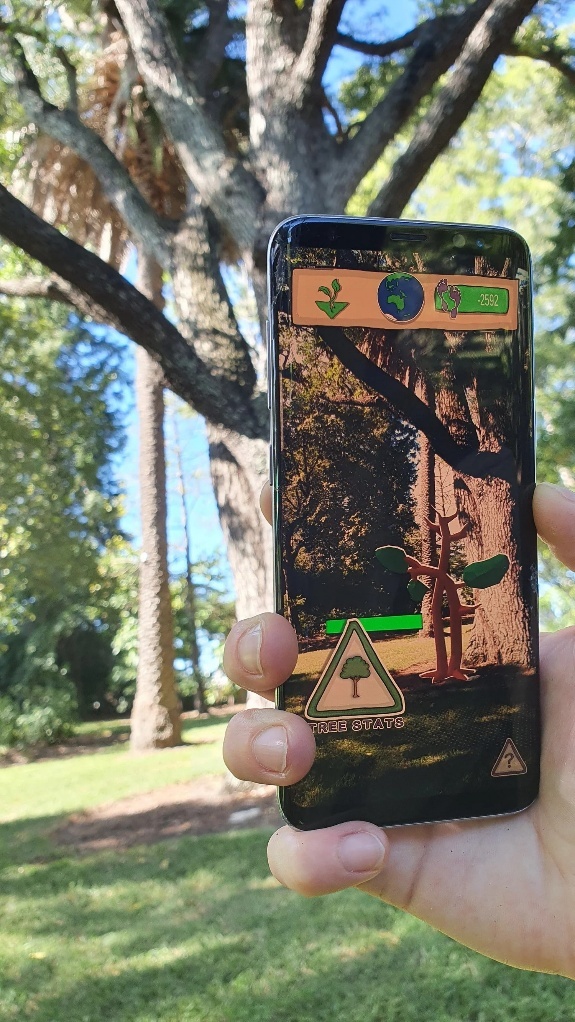
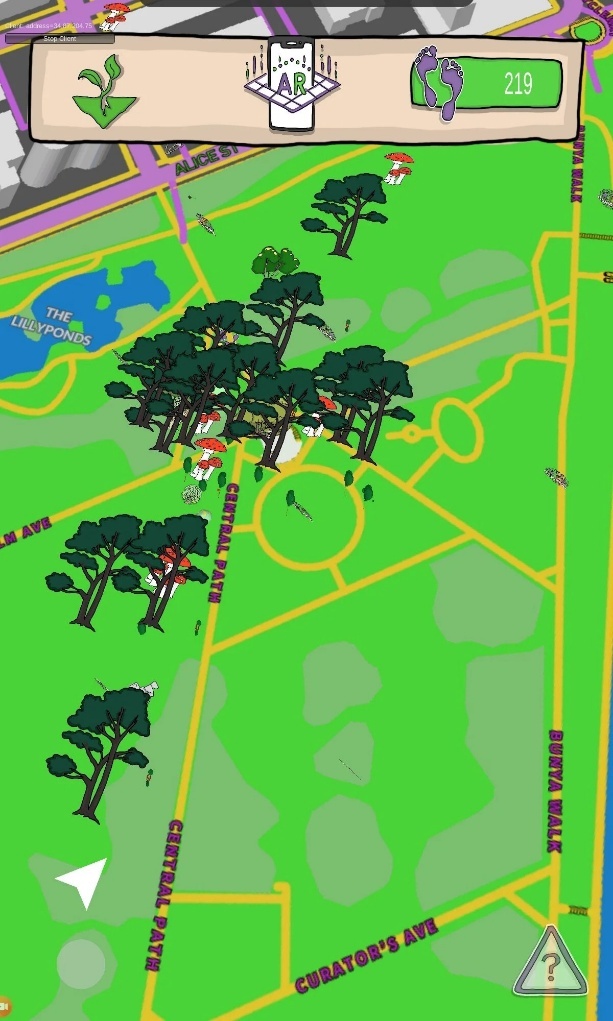
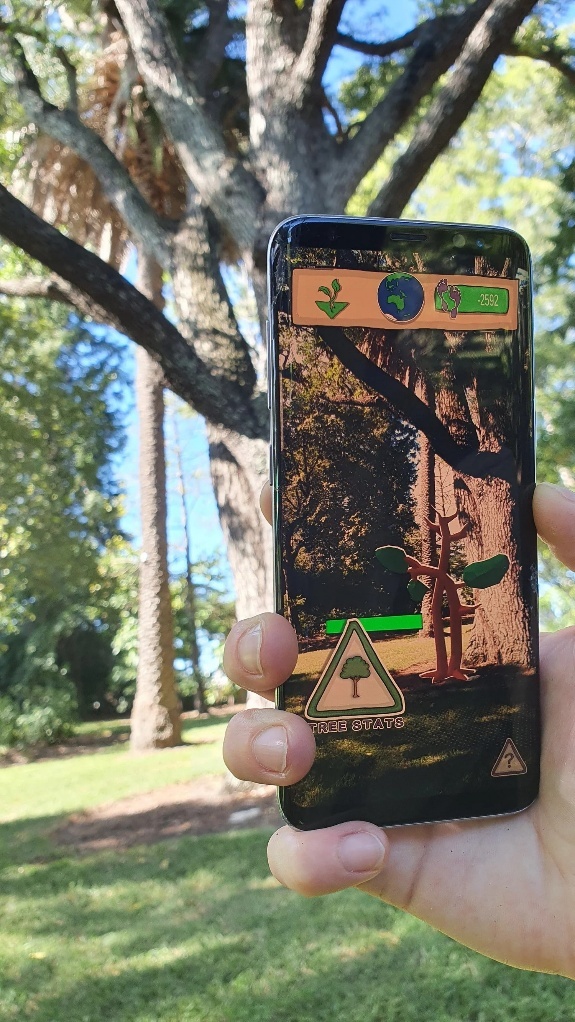
Virtual Footprints is a mixed-reality, location-based AR app developed by Libby Clarke and the OrCha Collective on the unceded lands of the Aboriginal nations whose Country comprises the state of Victoria. Available for free download via both iOS and Android app stores, it invites players to plant virtual trees in physical locations, layering speculative ecologies onto material surfaces through smartphone cameras and GNSS positioning. Each tree is drawn from a database of local Victorian species—native, introduced, or invasive—and accompanied by descriptions of ecological roles. Rather than rewarding “correct” choices, the game encourages reflection on how species are entangled in complex, contested ecosystems. Players can also view the collective forest that emerges, seeing how their contributions intersect with others nearby in an asynchronous record of shared participation (see figures 1 and 2 below). The app was both time-limited and geographically bounded. It was first deployed within Meanjin/Brisbane on the unceded lands of the Turrbal and Jagera peoples in March 2021, followed by a statewide Victorian version from November to December 2021.
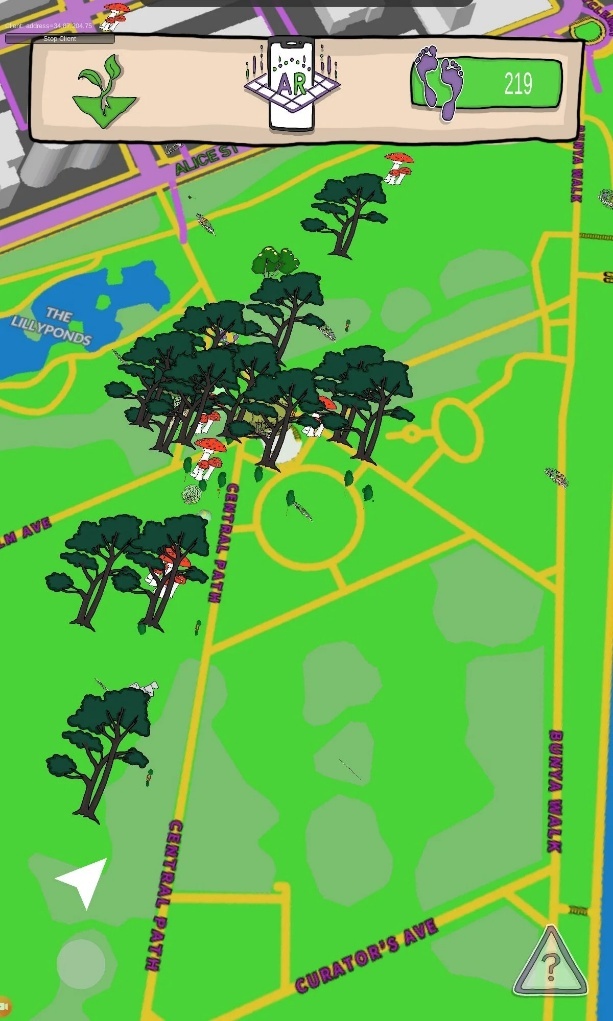
Virtual Footprints emerged from Clarke’s hybrid practice, spanning media art and outdoor recreation work. While studying at the Victorian College of the Arts, Clarke experimented with digital street art by placing QR codes around the city that linked to short animations. Simultaneously, she worked as a surf instructor, paintball guide, and forest zipline operator in rural Victoria. These parallel experiences reinforced “how lucky I am that I get to spend so much time outdoors and with nature” (Clarke interview transcript 2022), seeding her conviction that games could encourage, rather than deter, ecological engagement. This background shaped the app’s distinctive approach to AR mediation: Instead of using virtual overlays just to replace or enhance material environments, Virtual Footprints employs AR technology to make visible the ecological choices and histories already in place.
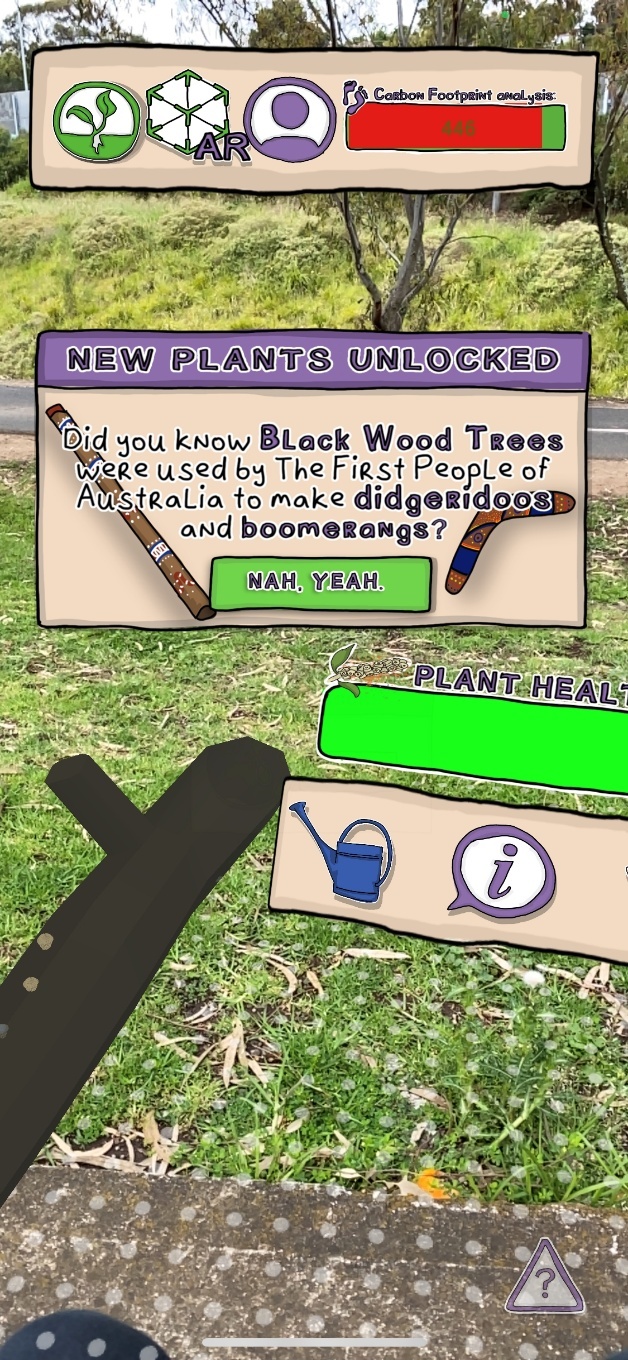
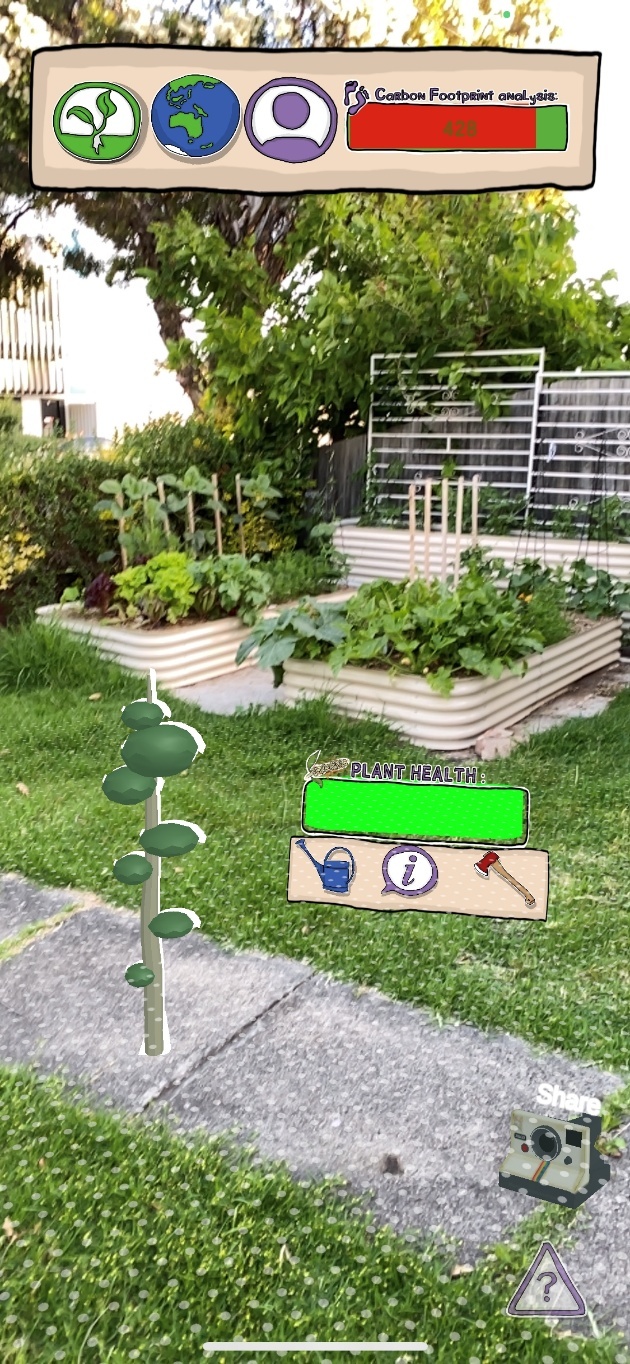
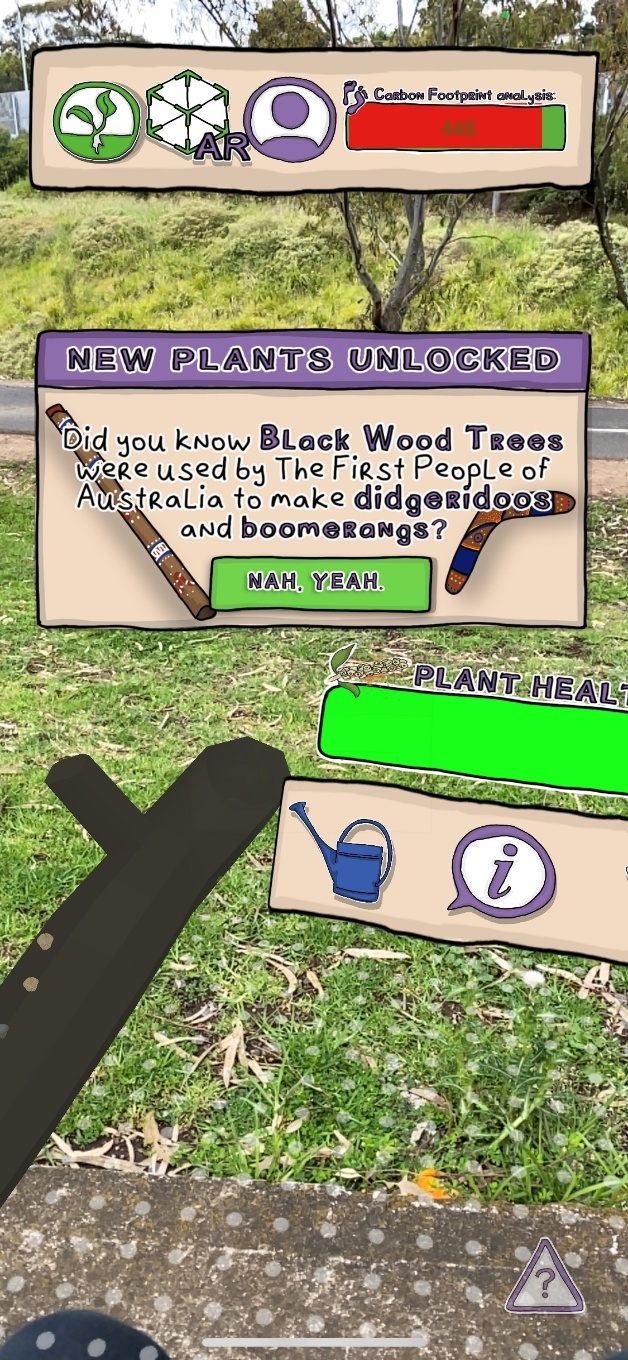
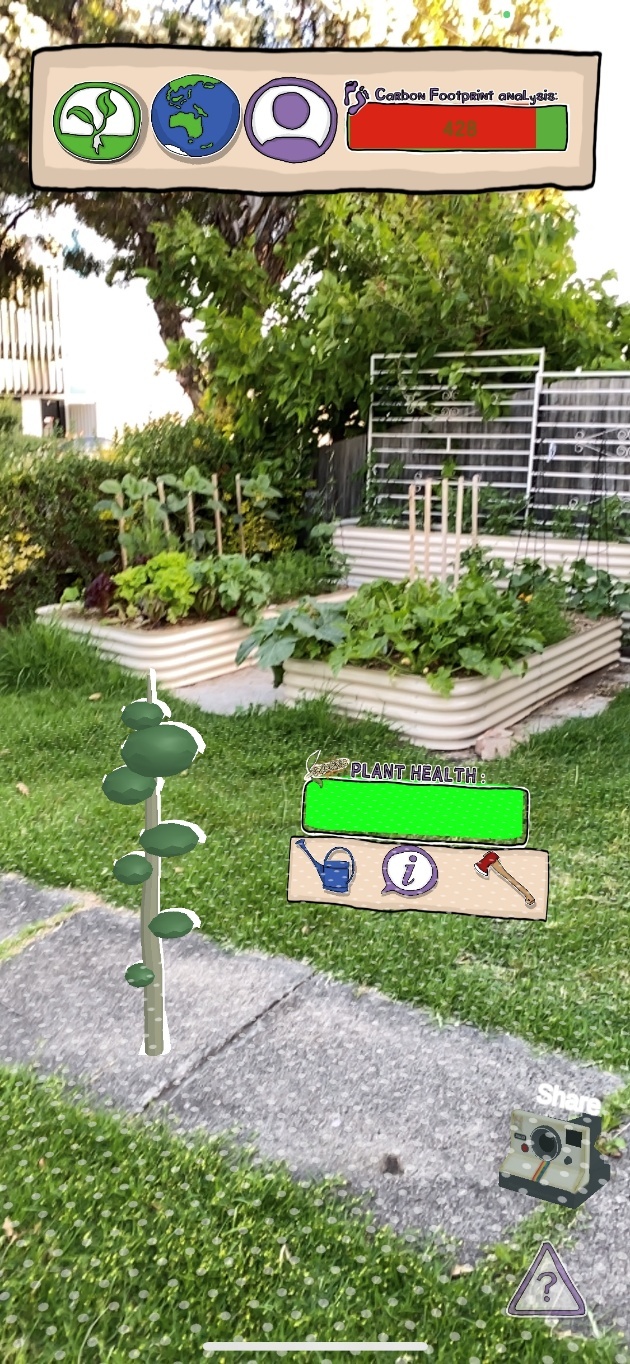
In contrast to many location-based games that frame environments as resources for conquest or optimization, Virtual Footprints foregrounds persistence, relationality, and ecological choice. The AR interface requires players to consider what species they introduce, what histories those species carry, and how their cumulative presence might reshape landscapes. Meanwhile, an embedded “carbon footprint analysis” system shows how native and non-native species planting shifts the overall ecosystem, reframing points not as victory conditions but as measures of external ecological fragility (see figures 3 and 4). This mechanic helps players reflect on how interventions can destabilize environments, while balanced planting can foster resilience.
Respect through “augmented choice”
Virtual Footprints cultivates respect through a kind of “augmented choice”—using AR overlays to make visible the ecological significance of species selection. Each plant carries contextual information and affects the game’s ecological score, prompting players to weigh impact and reflect on overlooked histories. The app also surfaces uncomfortable legacies of introduced colonial species, with Clarke (interview transcript 2021) noting how many people “don’t know that blackberries are actually really bad for the environment,” despite their visible spread across Victorian landscapes. By gesturing to such knowledge in plant descriptions, the game playfully encourages attentive engagement with local ecologies while revealing the hidden agencies and histories behind them. Yet the system’s openness can also limit respect. The AR feature allows trees to be planted indoors or in other contextually inappropriate locations—a playful feature that Clarke noted some users found amusing, but that risks trivializing ecological relationships. This tension reveals how AR technologies can simultaneously illuminate and obscure environmental complexity, depending on their implementation and the unanticipated actions they afford.
Reciprocity through asynchronous exchange
Reciprocity emerges through the quiet technological mediation of traces. Players plant virtual trees that others later encounter through their AR displays, layering individual actions into collective forests visible across a shared geographic interface. This asynchronous exchange offers a modest counterpoint to the extractive logics of commercial AR games, creating digital-material networks where choices contribute to communal ecological imaginaries, rather than to points tallies or leaderboard rankings. But this form of reciprocity is also fragile. During the Victorian deployment, only seventy-two users engaged over two months, despite the app’s free availability and promotional efforts. Built on commercial AR infrastructures but without comparable resources, the project was also beset by bugs that required “rebuilding” the app for Apple’s App Store, and server costs that consumed most of the app’s public funding (Clarke interview transcript 2022). These technical limits affected reciprocity, as sustaining a shared forest required infrastructure and labor that were difficult to maintain. The small numbers also highlight barriers to engagement in attention economies geared toward speed and reward, while the demographics of participation—likely mostly urban, digitally literate users—raise questions about whose ecological knowledge becomes visible through such platforms, and whose remains excluded.
Restoration as speculative mediation
Virtual Footprints approaches restoration speculatively rather than materially, using AR overlays to invite reflection on how small gestures might reshape attitudes toward place and environmental futures. The technology enables a form of “speculative ecology” where digital interventions prompt consideration of material possibilities without claiming a direct environmental impact. This approach acknowledges both the potential and the limitations of digital environmental mediation. The AR interface can spark reflection and ecological literacy, but whether this translates into material action—actual tree planting, garden alterations, conservation participation—remains uncertain. Clarke herself noted this uncertainty: “it’s hard to say if the app itself would actually encourage people to go out into the bush […] but it certainly did encourage people to sort of think about their interactions with nature and their choices of plants” (interview transcript 2022).
The app’s restoration potential lies, then, not in direct environmental remediation but in what might be called “relational repair”: using digital technologies to cultivate more thoughtful, historically informed relationships with local ecologies. Yet this speculative restoration also reveals the limits of individual-centered environmental media: While Virtual Footprints encourages reflection on species choice, it cannot address the structural conditions—urban planning, agricultural practices, climate policy—that fundamentally shape ecological possibilities. It enables new forms of environmental awareness, while remaining constrained by broader political and economic contexts that determine environmental futures.
Epiphyte
Where Virtual Footprints reworks everyday spaces through speculative ecological overlays, Epiphyte stages a different intervention rooted in material and sensorial engagement with Australian bushland. Developed by artist and researcher Matthew Riley in collaboration with Troy Innocent, Epiphyte emerged from Riley’s doctoral research exploring “how the experience of outdoor play in a bushland context via digital media could bring diverse community groups of varying ages and interests together” (Riley 2018, 45). The project was playtested at the HillsceneLIVE festival in Sherbrooke Forest, in Victoria’s Dandenong Ranges, on Wurundjeri Woi Wurrung country—a site characterized by dry sclerophyll forest, complex topographies, and the ongoing presence of Indigenous custodianship overlaid with settler histories (Dandenongs 2024). It was partly funded through a local council arts grant. It attracted thirty participants over two years (2016–17) across three separate playtesting sessions.
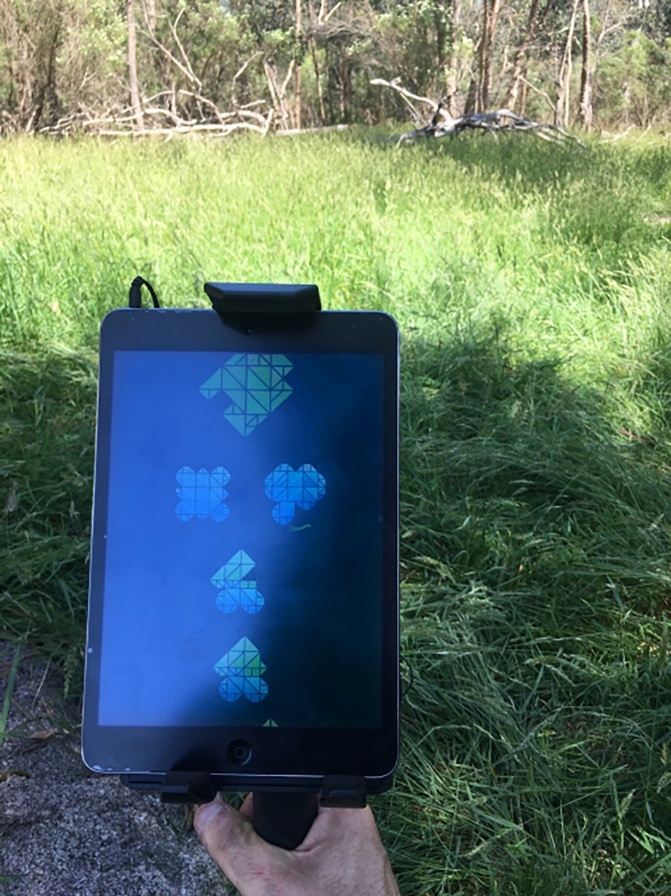
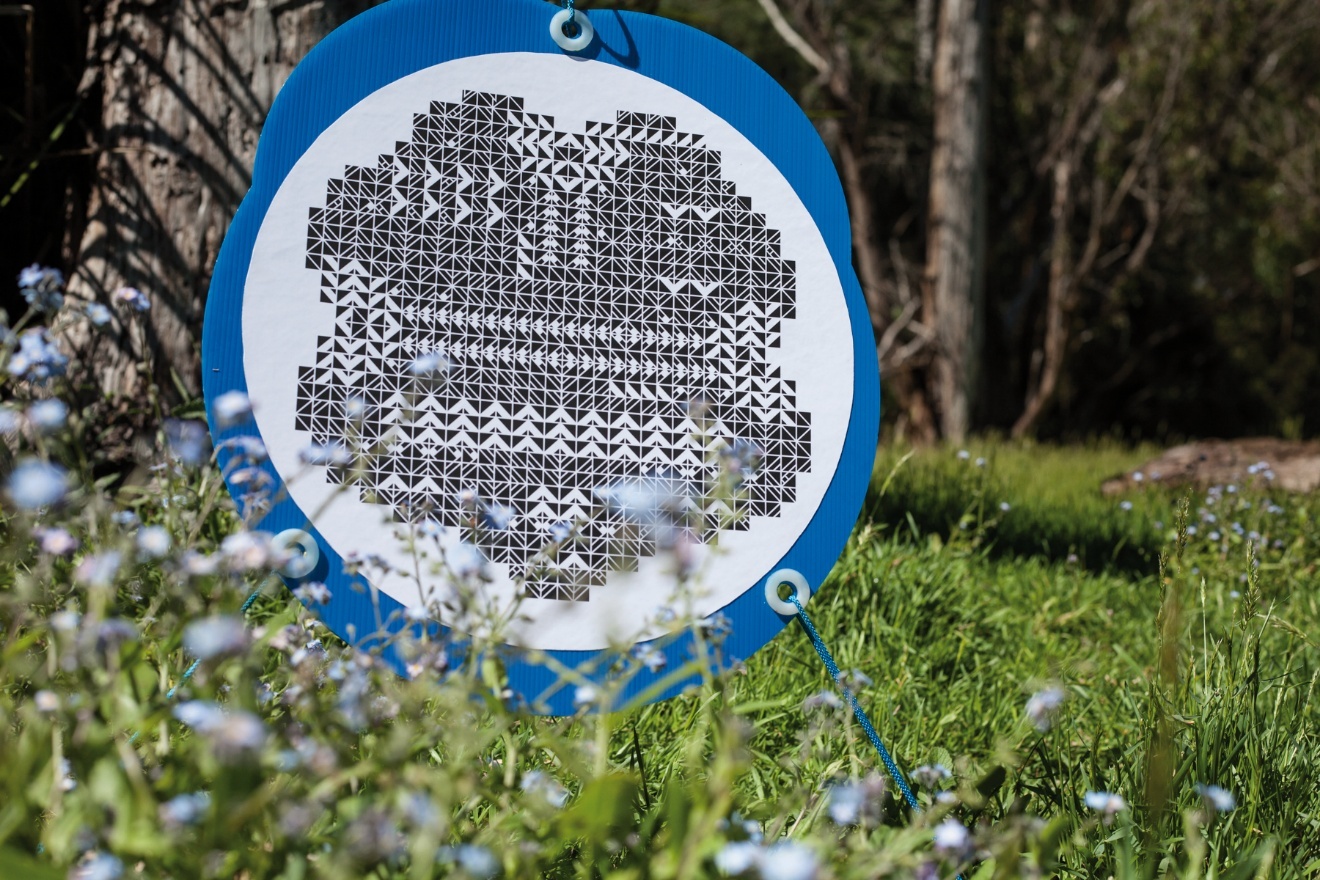
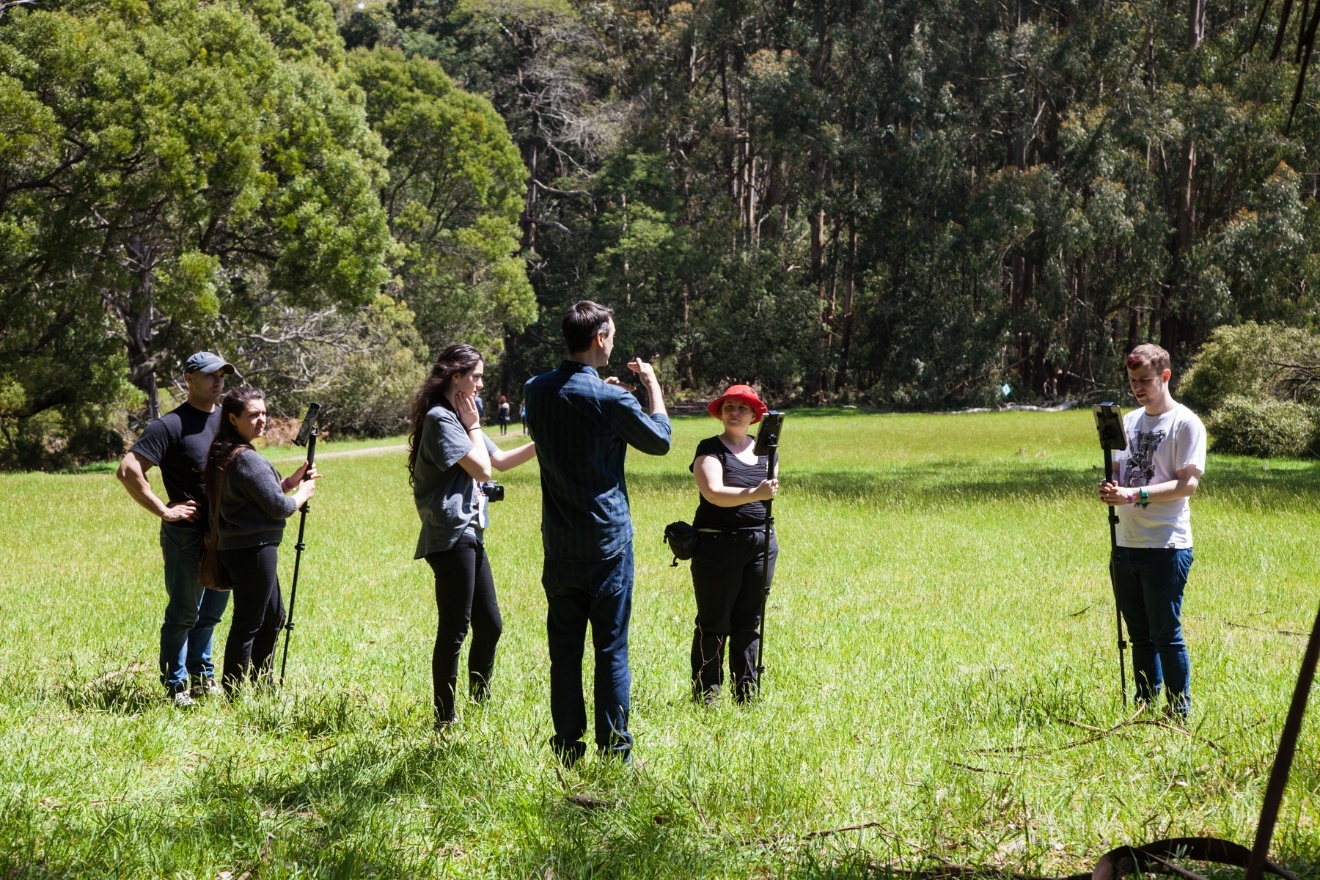
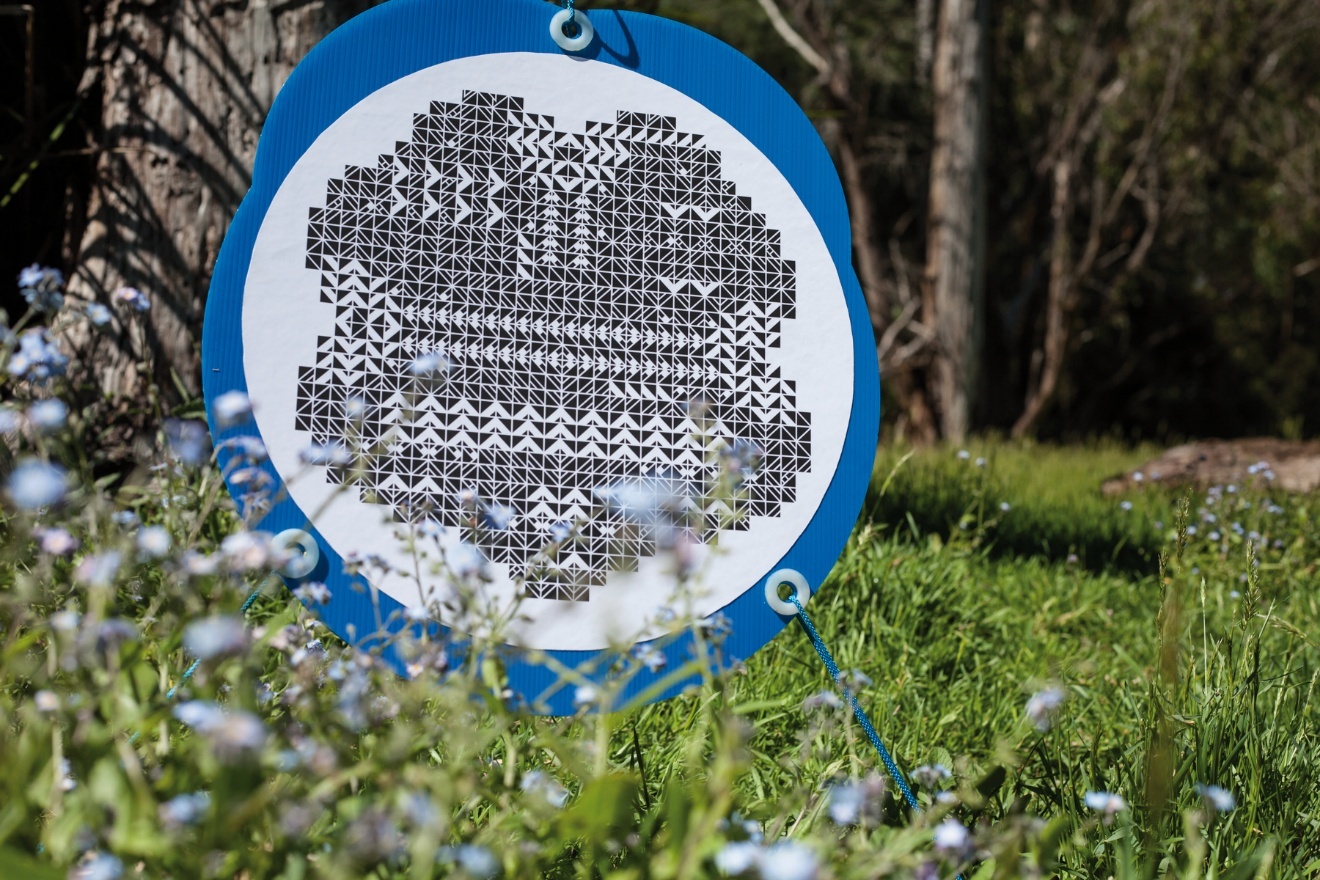
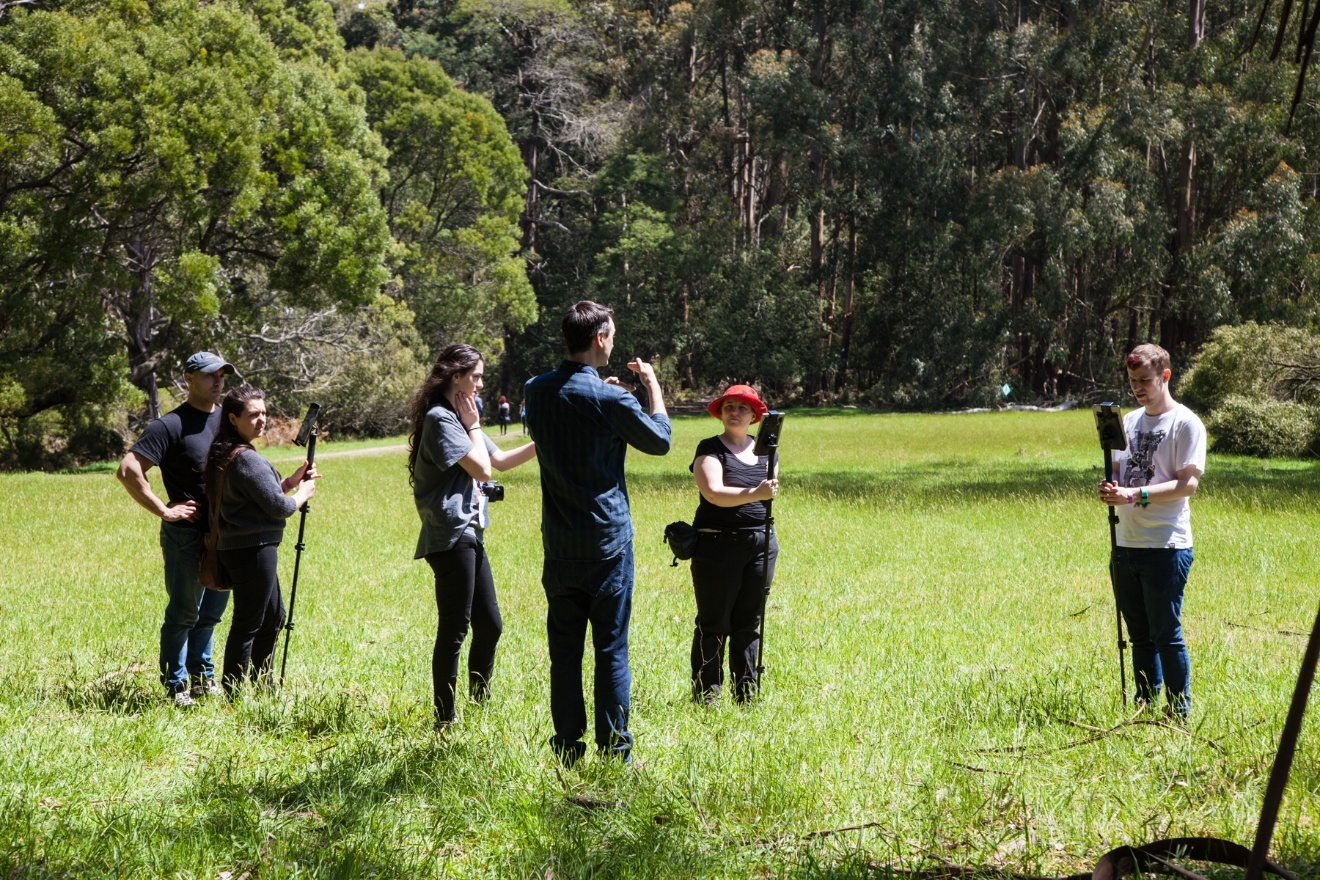
Unlike Virtual Footprints’ app format, Epiphyte was designed as a site-specific AR experience, anchored by physical markers installed along a forest trail. Participants borrowed iPad minis attached to monopods and followed a mapped thirty-minute bushwalk, encountering three colored markers—blue, green, and orange—each associated with different seed types. By scanning the markers through the iPad camera, players collected the relevant seed, accompanied by animation and sound (see figures 5 and 6). Collecting seeds through scanning was only the beginning: Seeds withered unless sustained by gathering additional elements (water and sunlight) from other markers dispersed through the bush. Players could combine the materials gathered to form evolving digital assemblages. At the walk’s conclusion, participants gathered in a circle to play their assemblages together, like a musical instrument—creating a conjoined artificial ecology reflecting both individual and collective trajectories through the landscape.
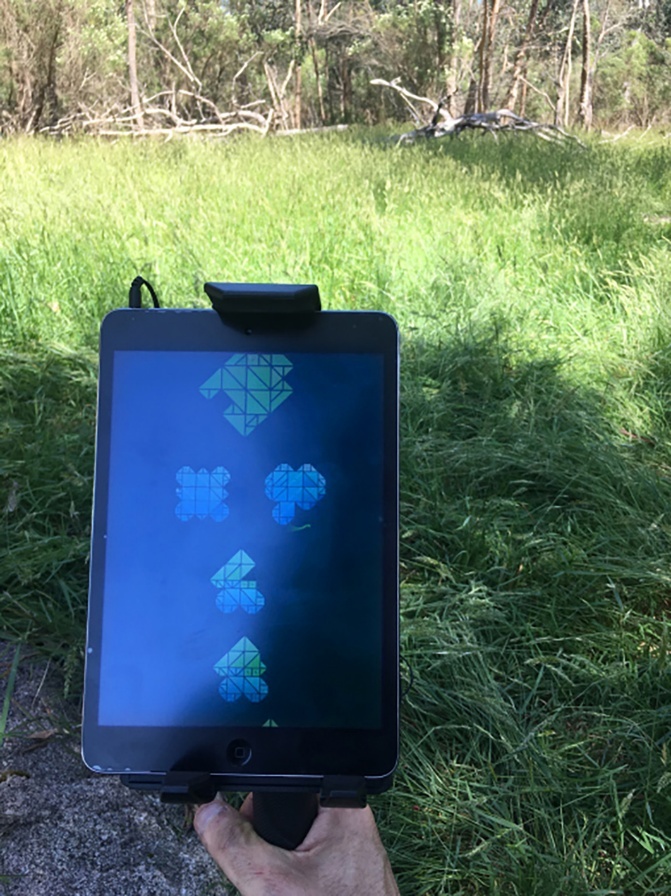

The project emerged from deeply personal circumstances that shaped its design approach. Riley had developed chronic pain from years of computer-based design work, forcing him to take leave and seek recovery through gardening and bushwalking in the Dandenong Ranges. As he reflected, this experience provided “a stark reminder that digital media is not a disembodied virtuality that leaves the body behind” (Riley 2018, 6). His recovery process raised a fundamental question: “How could two seemingly different systems, nature and digital technologies co-exist rather than be seen as disparate?” This embodied experience of technological harm and ecological healing informed Epiphyte’s approach to AR mediation—not as an escape from material constraints, but as delicate negotiation between digital and more-than-human systems.
Respect through embedded technological modesty
Epiphyte cultivates respect by refusing the seamless, high-fidelity demands of commercial AR, instead embracing what might be called “embedded technological modesty.” Unlike GNSS-driven games that overlay generic interfaces onto diverse environments, Epiphyte’s physical markers resembled something between orienteering codes and topographic symbols that blended subtly into the landscape. This deliberate low-tech approach demanded players pay close attention and move slowly to spot markers, encouraging them to oscillate between screen and world, and between mediated and unmediated forms of attention (see figures 7 and 8).
Riley (2018, 81) draws on the concept of “crossmedia ecology” to describe this layered system where digital and material elements co-constitute experience, rather than one simply supplementing the other. The behaviors of the collectible seeds echoed ecological dynamics of competition, symbiosis, and fragility, responding to care rather than mastery. There was no victory condition, optimal strategy, or final score—players’ agency remained diffuse, consequences were deferred, and relations were contingent rather than deterministic. As Riley (interview transcript 2021) noted, “even when I go for walks I take a lot of photos of fungi and mushrooms […] I’ve noticed that alters my engagement […] now I read the landscape differently.” Epiphyte builds on this altered attention to place, asking participants not to master the environment but to dwell within its uncertain relationalities. The forest becomes not backdrop or resource, but a thick, lively presence, only ever partially accessible through technological mediation.
Reciprocity through “attunement” and adaptation
Reciprocity in Epiphyte operates through what might be termed “attunement”—a subtle dance between human, digital, and more-than-human agencies where control gives way to responsiveness. Unlike games that adapt environments to player convenience, Epiphyte requires players themselves to adapt to the trail’s textures and rhythms. The bushland setting, with its absence of infrastructure and its sensory richness, actively resists the seamless flow of movement and accumulation typical of commercial location-based AR gaming in urban environments. Players must contend with the forest’s unruliness: Uneven ground, shifting light, unseen animals. Digital seeds respond to care, indifference, or interference in ways that are often subtle or unpredictable, creating a kind of reciprocal mediation between digital organisms, human players, and surrounding environment.
However, this reciprocal engagement was constrained by the significant infrastructural demands of staging the work. As Riley (interview transcript 2021) reflected, “the setup and the invitation for players into that world was quite demanding […] the labour of doing that was so extensive that we couldn’t really replicate that too often.” The project required hours of marker installation, device preparation, and participant transportation by car—intensive human labor and energy consumption that made this dynamic human-environment reciprocity possible. This tension reveals how even technologically modest interventions remain embedded within broader systems of resource extraction and energy expenditure, hindering the more tangible impacts of Epiphyte’s reciprocal approach.
Restoration as temporal and relational ethics
Epiphyte approaches restoration not through environmental repair but through a kind of temporal and relational ethics. The project was never intended to scale, commercialize, or persist. It embraced ephemerality as part of its ecological ethic. Unlike platform games that promise indefinite engagement, Epiphyte situated itself within temporal flows of change, degradation, and renewal that mirror forest ecosystems themselves. This refusal of permanence can be seen as critique of both extractive platform capitalism and fantasies of technological permanence that often underwrite environmental media projects. Reflecting on a follow-up project he is involved with, Riley noted his resistance to a proposed permanent digital infrastructure, preferring to “do an [ephemeral] artwork” instead (interview transcript 2021).
Epiphyte’s restoration potential lies in cultivating different forms of environmental relation grounded in humility, uncertainty, and recognition of humans as one agent among many within lively, more-than-human assemblages (Bennett 2010), rather than as central controllers of ecological systems. Through contemplative play that slows movement, fragments attention, and embraces partial, unstable encounters, Epiphyte models what it might mean to “stay with the trouble” of environmental crisis through technological mediation. Yet this speculative restoration also remained limited by this experimental scope and ephemerality. While individual participants surveyed in Riley’s thesis reported shifted environmental awareness, the project’s impact on broader ecological relations or environmental practices remains undocumented. Like Virtual Footprints, Epiphyte reveals both possibilities and constraints of using location-based play for ecological restoration. It can open space for different relations; but it remains constrained by the broader structural conditions that shape technological development and environmental futures.
Fragility as Critique: The Dilemma of Ecological Design
The projects discussed in this article demonstrate that location-based games do not inevitably reproduce the extractive logics of commercial applications. By embracing technological modesty, temporal deceleration, and ecological ethics, Virtual Footprints and Epiphyte gesture toward alternative relations between digital play, embodied movement, and environmental presence. Their significance, however, might lie less in what they accomplish than in what they refuse—and in what their design and enactment reveal about the limits of ecological design itself.
Viewed through the lens of respect, reciprocity, and restoration, these projects serve as a productive, if uneven, test case for thinking through the possibilities and limits of ecological play. They show that respect and reciprocity can be embedded in location-based game design, even if imperfectly. Ecosystems can be mapped with care, and reciprocal relations can emerge without becoming fully instrumentalized through metrics and rewards. Yet design affordances complicate this: for example, players planting trees indoors and infrastructural demands requiring energy-intensive servers and setup. Meanwhile, the projects show that of the three orientations, restoration proves most elusive. Neither project translates ecological attentiveness into material repair, and neither resolves the infrastructural contradictions binding digital play to extraction.
These limitations are not necessarily failures, but reflections of the conditions under which such projects operate. Both games are “fragile” in ways that commercial location-based platforms are not. Virtual Footprints attracted seventy-two users across two months and grappled with technical instability; Epiphyte reached thirty participants over three playtesting sessions and resists wider distribution. Both remain materially constrained, temporally bounded, and modest by design. Their small audiences, limited lifespans, and technical precarity stand in stark contrast to platform logics of growth, reproducibility, and accumulation.
From one optimistic perspective, this fragility can be read as a form of critique. By embracing slowness and ephemerality, the projects eschew extractive design logics. They prompt us to think about a different kind of significance and “impact”—measured not in reach or uptake, but in the very act of non-scaling itself. This aligns with existing ecogames scholarship arguing that material footprints matter: The ecological implications of a seventy-player project cannot be equated with those of a seventy-million-player platform (Abraham 2022). Smallness and ephemerality become the point. As Chang et al. (2024) suggests, the most radical ecological act in games might be refusal itself: favoring spaces where play is slowed, stalled, or withdrawn, unsettling expectations that every interaction must generate progress or optimization.
In this sense, Virtual Footprints and Epiphyte function not as models to be replicated, but as situated enactments of refusal whose very constraints perform their meaning. They cultivate practices of care, attention, and reciprocity not as solutions to crisis, but as rehearsals for inhabiting damaged places differently. They slow down when acceleration is demanded, refuse accumulation when growth is expected, and embrace ephemerality over permanence. They offer players temporary clearings where other relations might emerge—modeling ways of being with environmental crisis that challenge extraction’s temporalities. Seen this way, their value need not lie primarily in reeducating environmentally “deficient” subjects, but in how such interfaces and their approach might help inform participatory tools for situated inquiry, reflection, or decision-making within existing practices of environmental care.
Yet this argument has clear limits. Refusal and ephemerality also open deeper and more troubling questions around what counts as significance beyond material footprint and scholarly critique. If these projects reached only dozens of participants each, what exactly is their impact, and for whom? There is a tension here that cannot be easily resolved. To foster the attitudinal shifts these games gesture toward requires reaching people. Yet remaining nonextractive means resisting the very forms of scale through which such messages are typically amplified.
This tension pulls analysis toward familiar poles. On one hand, there is the temptation to defend small, fragile projects by insisting their influence exceeds their scale—that they matter because they model better relations, regardless of reach. On the other hand, there is the risk of concluding that such projects are ultimately inconsequential: too small to matter, too marginal to intervene meaningfully. Neither position is fully satisfying. Optimism risks setting aside structural limits in favor of ideological critique, while skepticism can quickly slide into nihilism and resignation to inaction.
In grappling with this impasse, McKeown’s (2025) critique of ecogames helps clarify the stakes. McKeown cautions that ecogames scholarship has increasingly adopted an optimistic rhetoric that risks enabling greenwashing by framing environmental crisis as solvable through design and behavior change. Against this, McKeown insists that climate catastrophe is already an unevenly lived condition, not a future problem to be averted. The task for games, then, is not to promise solutions, but to help people inhabit compromised presents without the consolations of false hope.
Read through this lens, the significance of Virtual Footprints and Epiphyte lies not in their capacity to enact alternative futures at scale, nor in their failure to do so. It’s in how they hold open the very question of impact itself. Their fragility neither redeems nor condemns them. Instead, it marks the point at which ecological design confronts its own limits—where the demand for easily measurable outcomes gives way to a much more difficult reckoning with what it means to act, care, and refuse within systems that can no longer be fixed from within.
Conclusion
This article has examined Virtual Footprints and Epiphyte not as solutions to environmental crisis, but as sites where the tensions of ecological game design become visible. Through the conceptual lens of respect, reciprocity, and restoration, I’ve shown how location-based games can cultivate care and attentiveness while remaining entangled in extractive infrastructures they cannot escape. The fragility of these projects—their small scale, limited reach, and technical precarity—is not incidental to their meaning, but central to how they negotiate the contradictions of ecological design.
Rather than resolving these contradictions, the projects invite a post-optimistic stance toward ecological play (McKeown 2025). They neither promise repair nor collapse into futility. Instead, they rehearse ways of inhabiting damaged environments that resist dominant temporalities of growth, accumulation, and optimization. In doing so, they suggest that the value of ecological games may lie less in demonstrable impact than in their capacity to slow, interrupt, or refuse the demand to solve. Such modest, imperfect experiments don’t offer futures to be engineered, but serve as practices for living with compromised presents—without guarantees, and without consolation.
This article does not engage the settler-colonial histories of the landscapes in which Virtual Footprints and Epiphyte are situated, nor interrogate “the bush” as an environmental imaginary shaped by ongoing dispossession and the erasure of Indigenous custodianship. More fundamentally, location-based games themselves are products of colonial infrastructures: GNSS originating as military technology, the maps they run on shaped by colonial cartography, the very act of playing them in settler-colonial countries occurring on stolen land. Virtual Footprints and Epiphyte both operate on the unceded lands of Aboriginal nations whose custodianship the paper has not engaged. Ecological attentiveness cannot be disentangled from histories of land theft and uneven responsibility, and addressing those relations is work that requires different relationships and accountabilities than this paper has built.
Similarly, the absence of sustained player perspectives reflects the projects’ modest scale and temporal fragility. These games reached relatively few participants, and their impacts remain partial, situated, and difficult to trace. Yet these absences are not external to the argument advanced here. They foreground questions that ecological game design cannot avoid: Who gets to participate in contemplative ecological play, what infrastructures and privileges enable such participation, and how location-based media might widen engagement without reverting to extractive models of reach and scale. In this sense, the limits of both the projects and my analysis are not necessarily failures to overcome. They expose the very conditions ecological design cannot escape, caught between care and extraction, reach and refusal.
Acknowledgments
This research was conducted in part on the unceded lands of the Wurundjeri Woi Wurrung and Boonwurrung peoples of the Kulin Nations in Narrm/Melbourne; and on the lands of the Tati Tati, Wadi Wadi, Latjilatji, Mutthi Mutthi, and other traditional owners of Country along the Murray River. I pay my respects to their Elders past, present, and emerging, and acknowledge that sovereignty over these lands and waters was never ceded.
I would like to thank Matthew Riley and Libby Clarke for generously sharing their time and insights about the projects discussed here. I am also grateful to Ben Abraham, Pablo Fernandez Velasco, and Danielle Wyatt for their thoughtful feedback on an early draft of this article, with special thanks to Abraham, whose Digital Games After Climate Change was a major inspiration for this work. I thank participants at the 2nd Geogames Symposium in Dublin for their generous comments and encouragement when I presented an earlier version of this paper. The writing of this paper has been supported variously by the Centre of Excellence in Game Culture Studies at Tampere University through the Academy of Finland Centre of Excellence 2018-2025 program; and the Centre for the Sciences of Place and Memory at University of Stirling through the Leverhulme Trust’s International Professorship program. Lastly, I am grateful to Alenda Chang for her editorial guidance and encouragement during the submission process, and to the reviewers for their particularly thoughtful and constructive feedback. Any errors and oversights remain entirely my own.
In this article I use GNSS (global navigation satellite systems) as a collective term for the American GPS (global positioning system), Russian GLONASS (global navigation satellite system), and the Chinese BeiDou system, among others. For more on these different systems, see Leorke and Wood (2025).
In this article I use location-based games to refer broadly to digital games that incorporate GNSS coordinates and/or real-world locations into their mechanics*. Location-based AR games* form a narrower subset, in which the player’s device camera is actively used to superimpose virtual objects or effects onto the surrounding environment. In practice, many games marketed as “AR” (such as Pokémon GO) make only limited use of these features, blurring the distinction between the two categories. For further discussion of how these technologies intersect in mobile play, see Alha et al. (2023).
I tested seven of the most popular or longest-running commercial location-based games on iOS between 2021 and 2023, based on popular news articles listing the top location-based games on Android and iOS by revenue in the United States. The games included Pokémon GO, Moomin Move (Tribered Oy, 2018), Jurassic World Alive (Ludia, 2018), The Walking Dead: Our World (Next Games, 2018), The Witcher: Monster Slayer (Spokko, 2021), Pikmin Bloom (Niantic, Inc., 2021) and Monster Hunter Now (Niantic, Inc., 2023). I played them for thirty-minute intervals each both at a park in inner Narrm/Melbourne on the unceded lands of the Wurundjeri Woi Wurrung and Boonwurrung peoples of the Kulin Nations; and in bushland about five kilometers outside a rural town north of Narrm on the unceded lands of the Tati Tati, Wadi Wadi, Latjilatji, Mutthi Mutthi, and other traditional owners of Country along the Murray River.